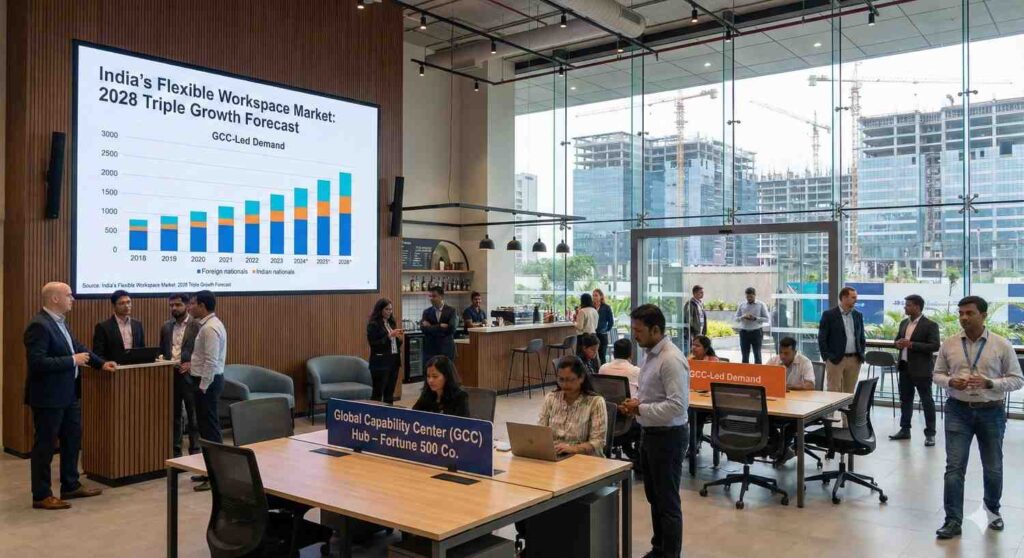
India’s flexible workspace market is projected to grow nearly threefold to USD 9–10 billion by 2028, driven by the rapid expansion of Global Capability Centers. A new Smartworks–UnearthIQ report highlights a major shift toward asset-light office models, with flex spaces emerging as the fastest-growing segment in commercial real estate.
India’s flexible workspace sector is poised for a major expansion, with market size expected to reach USD 9–10 billion by 2028, nearly three times its current value. This growth is being driven by the rise of coworking and managed office setups alongside the accelerating presence of Global Capability Centers (GCCs). The projection comes from a joint report by Smartworks Coworking Spaces Limited and UnearthIQ, which points to a deeper structural shift underway in India’s commercial real estate landscape.
At the core of this transition is a move away from traditional, capital-heavy office leasing toward asset-light, operational expenditure–led models. Enterprises across technology, finance, engineering, and research functions are increasingly prioritizing flexibility, speed to market, and scalability, factors that flex spaces are designed to deliver.
Commercial Real Estate Opportunity Expands
The report places India’s broader commercial real estate market on a strong growth trajectory. Currently valued at USD 50–60 billion, the sector is expected to scale up to USD 120–130 billion by 2030, reinforcing India’s position as the world’s fourth-largest commercial real estate market by economic activity. Much of this expansion is expected to come from office real estate, which remains central to enterprise growth and global operations.
A significant share of this momentum is linked to GCCs, captive offshore centers fully owned and operated by multinational corporations. Unlike outsourcing units, GCCs handle mission-critical functions such as product engineering, data analytics, cybersecurity, finance, and R&D, making workspace quality and agility a strategic priority.
GCCs Fuel Demand for Flex Spaces
India’s GCC ecosystem currently employs around 2.2 million professionals and continues to add 80,000-120,000 seats each year. This alone represents an annual revenue opportunity of USD 170–254 million for workspace operators. By 2030, GCCs are expected to require 160–200 million square feet of office space across Tier-1 and Tier-2 cities.
Crucially, flexible and managed workspaces are projected to account for 65–80 million square feet of this demand, nearly half of all GCC office requirements. Flex spaces enable enterprises to scale operations quickly, avoid long-term lease commitments, and operate from fully serviced, Grade A environments aligned with hybrid work models.
Policy Support and Capital Inflows Strengthen the Case
The report also highlights enabling factors, such as rising demand for Grade A offices, strong institutional capital inflows, and policy initiatives, such as the proposed Registration Bill 2025, which aims to digitize land and property registration and improve transparency. Together, these factors are creating a more efficient and investable real estate ecosystem.
Summing up the transformation, the report states, “The USD 22–26 billion office segment, which forms 40–50% of the total market, is being reshaped by GCC and IT/ITeS growth, hybrid work models, and Tier-2 expansion. Within this shift, branded flex spaces have emerged as the fastest-growing category, rapidly outpacing traditional offices.”