
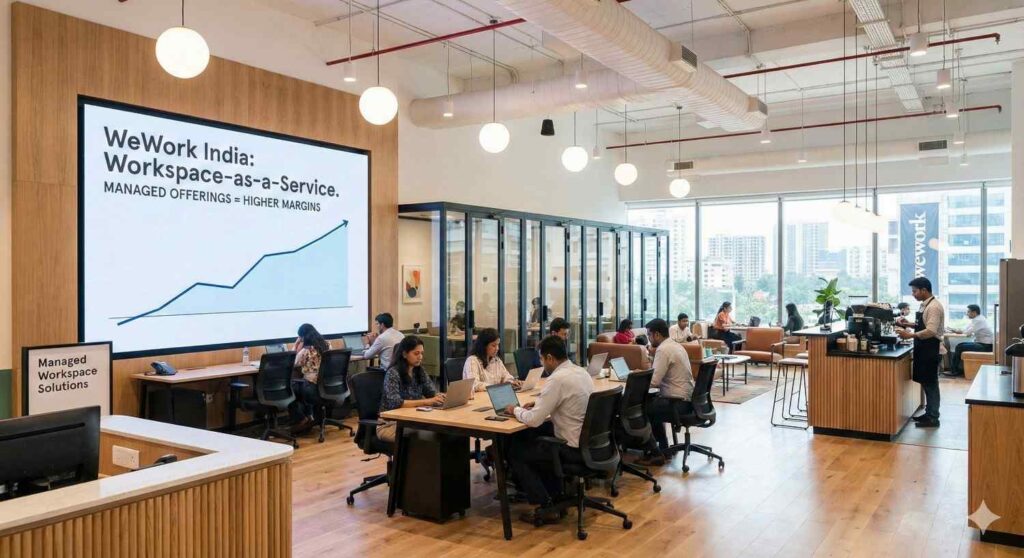
WeWork India is evolving from a coworking operator into a workspace-as-a-service provider to meet rising enterprise demand. CEO Karan Virwani says managed services and value-added offerings are driving margin expansion, as large companies increasingly outsource non-core workplace functions amid hybrid work and operational restructuring.
WeWork India is repositioning its business model to deepen its engagement with large enterprises and improve profitability. Moving beyond its roots as a coworking space provider, the company is increasingly positioning itself as a managed services partner offering end-to-end workplace solutions. Managing Director and CEO Karan Virwani said the shift reflects the evolution of client expectations since WeWork entered India nearly 8 years ago. “We move from co-working to now what we’re doing is workspace as a service,” he said, describing the broader direction of the company.
Enterprise Demand Reshapes the Model
In its early years, WeWork India primarily catered to startups and mid-sized firms seeking flexibility and shorter-term office commitments. Over time, however, demand from large enterprises has significantly altered the company’s portfolio mix. Virwani said WeWork India today serves a wide range of users, from freelancers looking for short-term desks to multinational companies seeking large, customised office footprints. This closer engagement with enterprise clients has also helped the company better understand how organisations are adapting to hybrid work, consolidation, and changing operating structures.
Beyond Desks and Offices
As enterprises rethink how work gets done, WeWork India sees opportunities beyond physical office space. Virwani noted that many companies prefer outsourcing non-core workplace functions rather than managing them internally. Services such as employee transportation, food and beverage management, and workplace experience design are increasingly becoming part of WeWork India’s offering. “Over time, we want to move up the value chain and try to do a bit more for these companies,” he said, allowing clients to stay focused on their core business priorities.
Value-Added Services Drive Margins
This strategic pivot is also closely linked to profitability. According to Virwani, value-added services already contribute around 14–15% of WeWork India’s revenue, which is higher than many peers in the flexible workspace segment. Even modest growth in this share can have a meaningful impact on the bottom line. “Even if it moves up 1–2%, at this base of revenue, it almost all flows down to the bottom line,” he said, explaining that these offerings are largely execution-led and do not require heavy capital investment.
A Gradual, Measured Transition
Virwani emphasised that the move toward workspace-as-a-service will be gradual rather than aggressive. The company plans to carefully scale its managed offerings, particularly for enterprise clients increasingly comfortable outsourcing operational functions. WeWork India expects value-added services to add a few more percentage points to revenue in the near to medium term, directly supporting margin expansion while aligning with broader workplace trends.
Aligning With Market Shifts
The strategy comes at a time when enterprises across India are seeking flexibility, efficiency, and better workplace experiences without adding operational complexity. WeWork India’s focus on managed services positions it well to capture this demand while reducing dependence on pure desk rentals. With a current market capitalisation of about ₹8,056.81 crore, investor attention remains firmly on how successfully the company executes this transition toward a higher-margin, services-led growth model.