
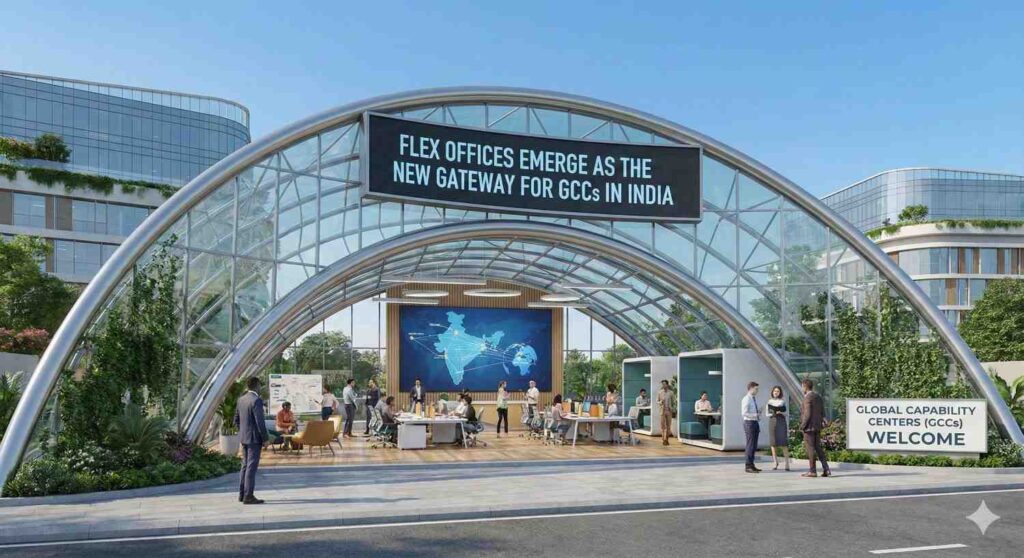
Flexible workspaces are becoming the preferred launchpad for Global Capability Centres entering India. With GCCs expected to drive up to 200 million sq. ft. of office demand by 2030, flex operators are capturing a growing share by enabling faster entry, asset-light expansion, and end-to-end operational support across key office markets.
Flexible workspace operators are increasingly positioning themselves as the first point of entry for Global Capability Centres (GCCs) looking to establish or scale operations in India. Industry experts say overseas companies are no longer viewing flex offices as temporary solutions, but as strategic platforms that help them move quickly from market entry to execution. This shift is being driven by the need for speed, simplicity, and operational certainty in a highly competitive talent and real estate landscape.
According to industry estimates, GCCs are expected to require 160–200 million sq. ft. of office space by 2030. Of this, flexible workspaces are projected to capture 65–80 million sq. ft., accounting for nearly 40% of total GCC-led demand. This marks a clear transition toward asset-light, Opex-led models, particularly for first-time entrants and fast-scaling teams.
Speed-to-Market Drives Flex Adoption
Experts note that today’s GCCs are less focused on long-term leases and more on rapid setup and execution. “GCCs entering India today are no longer just leasing square footage; they are prioritizing speed-to-market,” said Harsh Binani, Co-founder of Smartworks. He added that companies want to move from entry to execution without dealing with fragmented vendor ecosystems, a gap that managed and flexible workspace platforms are now filling at scale.
This need for integrated solutions is pushing flex operators upstream in the decision-making process. Many are now engaged at the planning stage, helping global firms design scalable workplace strategies rather than just offering desks.
A Broader and Deeper GCC Opportunity
India’s GCC ecosystem has expanded significantly over the past decade, growing from around 750 centres to more than 1,700 today. However, experts believe headline numbers underestimate the true opportunity. “Most analyses still undercount the wave of smaller, specialized ‘nano’ and mid-sized centres quietly entering across sectors and cities,” said Vibhor Jain, Founder and CEO of Carbon Guardians.
He noted that for these firms, flexible workspace partners act as extended operations teams, offering compliant infrastructure, secure IT, HR support, regulatory guidance, and scalable models ranging from pilot setups to full build-operate-transfer frameworks.
Flex Operators Tap a Growing Services Economy
India’s more than 1,850 GCCs currently employ close to 2.2 million professionals and add 80,000–120,000 seats each year. This expansion represents an annual opportunity of $170–254 million for workspace operators. “India’s GCC growth is a speed-to-market and execution story,” said Aashish S Shukla, Founder and Managing Director of CorporatEdge, highlighting that flex spaces are becoming the entry runway for global firms seeking quick and compliant launches.
A Hyper-Growth Phase for Flex Real Estate
The flex space market in India, currently valued at $3–4 billion, is projected to grow to $9–10 billion by 2028, driven largely by GCC expansion. Within the $22–26 billion office segment, branded flex spaces are emerging as the fastest-growing category, reshaping how global companies enter and scale in India’s top office hubs and beyond.