
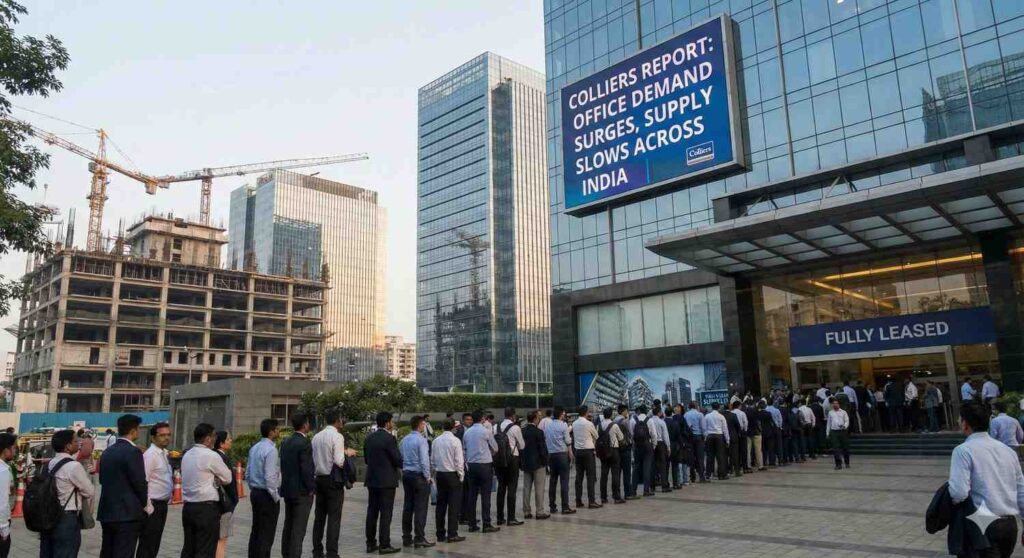
India’s office market saw demand outpace supply in 2025, with Delhi-NCR and Mumbai recording sharp declines in new office completions. Colliers noted strong leasing from technology firms, BFSI players, and GCCs, which tightened vacancies, strengthened rentals, and reinforced a landlord-favourable trend across major Indian cities.
India’s commercial real estate market is showing clear signs of a supply-demand imbalance. According to Colliers India, new office supply declined sharply in several major markets in 2025, even as leasing activity remained strong across the country’s top business hubs. Delhi-NCR and Mumbai were among the most affected, reporting a 15 per cent and 37 per cent drop in fresh office completions, respectively. This slowdown came at a time when domestic companies and global firms continued to actively seek high-quality office spaces.
Across the seven major cities—Bengaluru, Delhi-NCR, Mumbai, Hyderabad, Chennai, Pune, and Kolkata—office demand exceeded new supply during the year. As a result, vacancy levels tightened, creating upward pressure on rentals and signalling a shift toward a more landlord-driven market.
City-Wise Trends Reveal Sharp Contrasts
Colliers data highlights stark regional differences. In Delhi-NCR, new office supply fell to 7.4 million square feet in 2025 from 8.7 million square feet a year earlier. Mumbai witnessed a steeper contraction, with fresh supply declining to 5.2 million square feet from 8.3 million square feet in 2024. Hyderabad also saw a slowdown, with new supply dropping 21 per cent to 10.8 million square feet.
Kolkata recorded the sharpest decline, as new completions plunged 80 per cent to just 0.1 million square feet. In contrast, southern and western markets showed stronger development momentum. Bengaluru led the recovery with a 15 per cent rise in new supply to 17.5 million square feet, while Chennai more than doubled its supply to 4.5 million square feet. Pune also posted a significant jump, with new office supply rising to 11 million square feet from 5.3 million square feet.
Leasing Activity Remains Resilient
Despite uneven supply trends, overall office leasing remained healthy. Total absorption across the seven cities rose 6 per cent year-on-year to 71.5 million square feet in 2025. Technology companies and BFSI firms continued to anchor demand, while foreign enterprises setting up Global Capability Centres (GCCs) played a growing role in driving leasing of Grade A office assets.
Colliers noted that the supply crunch is already reshaping market dynamics. “With demand outpacing supply in recent times, overall vacancy levels fell by 49 basis points, while average rentals strengthened by up to 15 per cent YoY across major cities,” the consultancy said.
Developers, REITs, and the Investment Landscape
Leading developers such as DLF, Prestige Group, Embassy Group, K Raheja Group, RMZ, and Sattva Group continue to dominate India’s office sector. At the same time, the REIT market is expanding its footprint. India currently has four office-focused REITs, including Embassy Office Parks REIT, Brookfield India Real Estate Trust, Mindspace Business Parks REIT, and Knowledge Realty Trust.
Adding to this momentum, Bengaluru-based Bagmane Group has filed draft papers with SEBI for its Bagmane Prime Office REIT, aiming to raise up to ₹4,000 crore through an IPO. As supply remains constrained and demand stays strong, office assets—and flexible workspace portfolios—are likely to remain firmly in focus for investors in the coming year.