An alternative investment fund managed by ICICI Prudential Asset Management Company has acquired a major Grade-A office property in Pune, marking another step in its strategy to build a portfolio of income-generating commercial real estate assets. The acquisition was completed through the ICICI Prudential Office Yield Optimiser Fund – Series II, which purchased approximately 3.88
An alternative investment fund managed by ICICI Prudential Asset Management Company has acquired a major Grade-A office property in Pune, marking another step in its strategy to build a portfolio of income-generating commercial real estate assets.
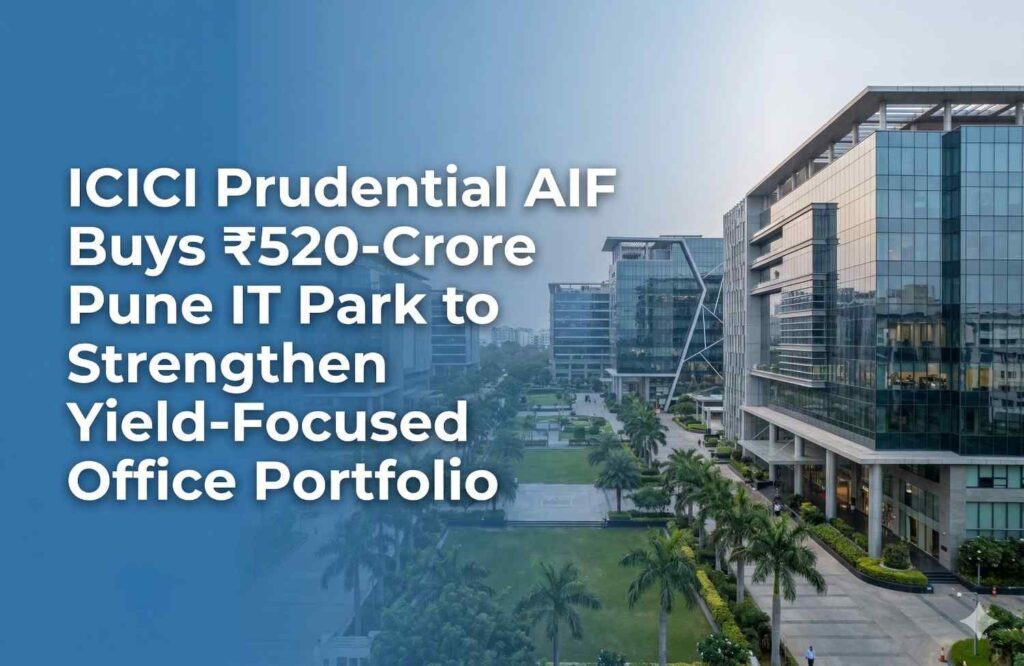
The acquisition was completed through the ICICI Prudential Office Yield Optimiser Fund – Series II, which purchased approximately 3.88 lakh square feet of office space at Aditya Shagun Infinity IT Park in Baner, Pune, for about ₹520 crore. The property has been developed by K Raheja Group in partnership with Shagun Developers.
This move reflects the increasing interest from institutional investors in stabilised office assets that offer predictable rental income and long-term capital appreciation.
Strong Tenant Profile and Long Lease Visibility
The IT park is already leased to multinational companies such as Eaton Corporation, Accenture, and Jaguar Land Rover. These established tenants contribute to the asset’s stable occupancy profile and long-term income visibility.
The property carries an effective annual rent escalation of approximately 4.7 per cent and a weighted-average lease tenure of nearly 9 years. Such long-tenure leases are often preferred by institutional funds because they provide predictable rental flows and reduce income volatility.
For investors, these characteristics make the asset particularly attractive in a market where stable yields and tenant quality remain key decision factors.
Yield Strategy Behind the Acquisition
The ₹2,000-crore Category II AIF focuses on acquiring completed commercial properties that are already leased to credible tenants. Its broader investment thesis is to generate returns of around 15–16 per cent through a combination of rental income and asset value appreciation.
The fund’s strategy aligns with the broader financialisation of India’s commercial real estate market, where professionally managed vehicles are increasingly providing investors with access to institutional-grade office assets.
Direct ownership of Grade-A commercial property often requires large investments—typically between ₹10 crore and ₹20 crore or more. Through the AIF structure, investors can participate with entry tickets as low as about ₹1 crore, making premium real estate exposure more accessible.
Pooling investor capital also gives the fund stronger negotiating power, enabling it to secure rental yields of around 7.5–8 per cent. This compares favourably with the 5–6 per cent yields typically available to individual investors purchasing office assets directly.
Building a Diversified Office Portfolio
The Pune deal is the latest addition to the fund’s growing real estate portfolio, which spans office parks, retail assets, logistics parks, warehouses, and data centres across major Indian business hubs.
Earlier this year, the fund acquired about 1.72 lakh square feet at Cybercity IT Park in Magarpatta, Pune, in a transaction valued at around ₹194 crore. The property is leased to WNS Global Services under a five-year lease agreement with annual rent escalation of roughly five per cent.
The fund has also invested in assets across key markets, including Mumbai, Bengaluru, Chennai, Hyderabad, and the National Capital Region.
These investments include office space at iThink Techno Campus in Kanjurmarg-Powai and a property at Centennial IT Campus in Brookefield leased to Atos SE.
Institutional Capital Driving Office Market Growth
The continued expansion of AIF-led investments highlights the growing role of institutional capital in shaping India’s commercial real estate landscape. As global occupiers expand and office demand remains steady in technology-driven markets like Pune and Bengaluru, stabilised office assets are becoming increasingly attractive to yield-focused investors.
For the flexible workspace and managed office ecosystem, the trend also signals long-term stability in the underlying office market—an important factor as operators and landlords align around hybrid workplace models and enterprise leasing strategies.