
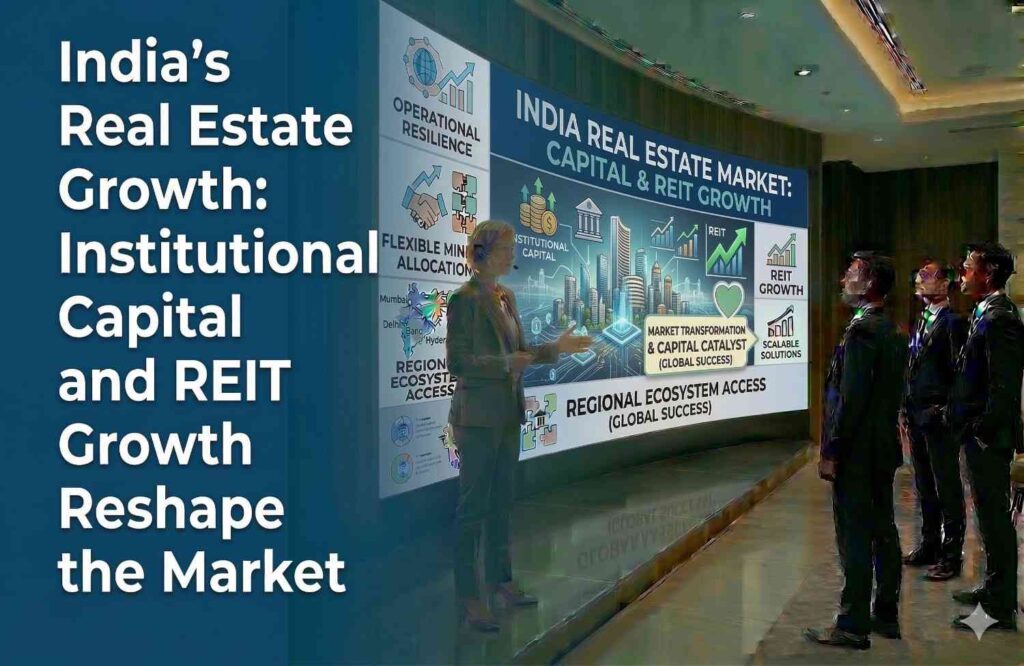
India’s real estate sector is witnessing strong growth driven by economic stability, record institutional investments, and rapid REIT expansion. With $14.3 billion in inflows in 2025 and the REIT market value rising sixfold since 2020, the sector is becoming more organised, attracting global investors and expanding beyond Tier-1 cities into emerging markets.
India’s real estate sector is entering a new phase of expansion, supported by robust economic fundamentals and sustained government focus on infrastructure development. According to industry estimates, the country’s GDP is projected to grow at around 7.6 per cent in FY26, reflecting resilience despite global economic uncertainties.
This growth is driven by strong performance across key sectors, including services, manufacturing, and construction. Increased capital expenditure and rising domestic consumption are also playing a crucial role in maintaining momentum. At the same time, infrastructure initiatives and improved connectivity are accelerating construction activity and boosting investor confidence across real estate segments.
Institutional Investments Reach Record Levels
One of the most significant drivers of this growth is the surge in institutional capital flowing into the real estate sector. As per data from the “India Real Estate Investment Market Outlook 2026” report by CBRE, equity investments reached a record $14.3 billion in 2025, marking a 25 per cent year-on-year increase.
A large portion of this capital has been directed towards office assets, commercial developments, and development sites, indicating strong investor confidence in income-generating real estate. Institutional investors, including global funds and private equity firms, are increasingly viewing India as a stable and high-growth market.
This trend is also contributing to the formalisation of the sector, making it more transparent and structured for both domestic and international stakeholders.
Tier-I Cities Lead, Tier-II Markets Gain Momentum
Major metropolitan regions continue to dominate investment activity. Cities like Mumbai, Bengaluru, and Delhi-NCR accounted for more than half of total equity inflows in 2025, reinforcing their position as primary hubs for commercial real estate and corporate expansion.
These cities remain attractive due to their strong office markets, presence of multinational companies, and established infrastructure. However, there is also a noticeable shift towards emerging markets.
Cities such as Indore, Coimbatore, and Ludhiana are witnessing growing investor interest as businesses expand beyond traditional urban centres. Improved connectivity, lower costs, and industrial growth are making these Tier-II cities viable alternatives for real estate investments.
REITs Transform the Investment Landscape
Another major development shaping the sector is the rapid growth of Real Estate Investment Trusts (REITs). These investment vehicles enable individuals and institutions to invest in income-generating real estate assets, such as office buildings and commercial complexes.
India’s REIT market has expanded significantly over the past few years. Market capitalisation has grown from approximately ₹26,400 crore in FY2020 to around ₹1.6 trillion by September 2025, representing a nearly sixfold increase.
This growth is being supported by regulatory reforms aimed at improving liquidity and expanding investor participation. Measures such as allowing banks to lend directly to REITs and classifying them as equity-like instruments are making them more attractive to mutual funds and institutional investors.
Rising IPO Activity Signals Market Maturity
The increasing number of real estate-related initial public offerings (IPOs) is another indicator of the sector’s evolving maturity. Several companies in the commercial real estate and REIT segments have entered the public markets in recent years, providing investors with more opportunities to participate in the sector’s growth.
These developments are helping create a more structured and transparent investment environment, reducing risks and improving accessibility for a wider range of investors.
A More Organised and Investor-Friendly Future
The combination of strong economic growth, rising institutional participation, and regulatory support is transforming India’s real estate sector into a more organised and investor-friendly market.
As capital inflows continue and new investment vehicles gain traction, the sector is expected to witness sustained growth across both residential and commercial segments. The expansion into Tier-II cities further highlights the broadening of opportunities beyond traditional markets.
Overall, India’s real estate landscape is evolving into a dynamic and resilient asset class, attracting long-term investments and supporting the country’s broader economic growth trajectory.