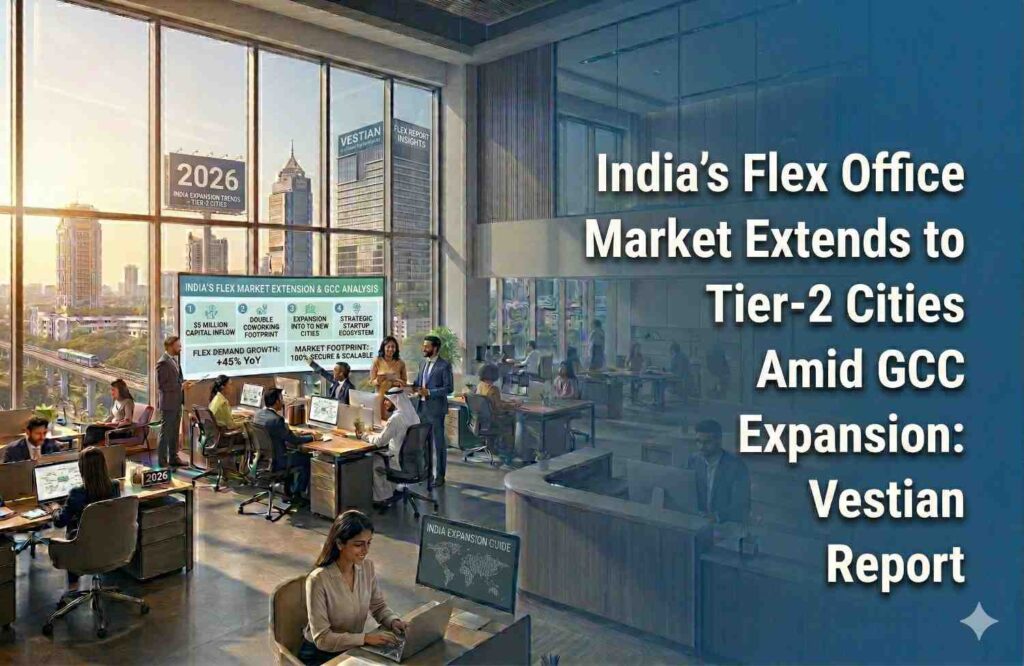
Tier-2 cities are rapidly transforming into key office markets, driven by lower costs, expanding flex workspaces, and growing GCC presence. With over 575 centres and strong demand for Grade-A, sustainable spaces, these cities are attracting enterprises seeking scalability, efficiency, and long-term growth beyond metro markets.
India’s office market is undergoing a major transformation, with Tier-2 cities stepping into the spotlight as high-growth commercial hubs. While metro cities have long driven demand, rising real estate costs and infrastructure pressure are pushing companies to explore alternative locations.
According to Vestian, this shift is being fueled by the need for scalable, cost-efficient, and sustainable office solutions. As urban capacity tightens in major metros, Tier-2 cities are offering a compelling value proposition—combining affordability with improving infrastructure and connectivity.
Flex Workspaces Drive Expansion
Flexible workspace operators are actively expanding into these emerging markets, capitalising on rising enterprise demand. As of February 2026, Tier-2 cities host over 575 flex centres, covering approximately 8.8 million sq ft. This accounts for nearly 29% of India’s total flex centres and over 9% of the national flex stock.
This growth highlights how flex operators are no longer focused only on Tier-1 cities. Instead, they are building distributed portfolios across high-growth urban corridors, enabling companies to adopt hub-and-spoke models and decentralised operations.
Cost Advantage Attracts Enterprises and GCCs
One of the biggest drivers behind this shift is cost arbitrage. Flexible workspaces in Tier-2 cities offer savings of up to 50% compared to metro markets, making them highly attractive for both domestic firms and multinational corporations.
This advantage has already led to significant traction from Global Capability Centres (GCCs). More than 200 companies have set up over 300 GCC bases across Tier-2 cities, primarily led by sectors such as IT-ITeS, consulting, BFSI, and engineering.
While GCCs are not yet the dominant demand driver for flex spaces, their presence is steadily increasing. Nearly 9% of flex centres in these cities cater to GCC-led operations, while 16% of GCC bases operate within flexible workspace environments.
Rising Demand for Grade-A and ESG Spaces
As demand matures, the focus is shifting toward higher-quality office infrastructure. Currently, only 26% of flex centres in Tier-2 cities are located in Grade-A buildings, and around 60% operate within dedicated office assets.
However, the trend is clearly evolving. Over 53% of GCC-occupied flex centres are already housed in Grade-A buildings, with 19% in green-certified spaces. This indicates a growing preference for institutional-grade, ESG-aligned workspaces that support long-term operational efficiency and employee well-being.
Developers and operators are increasingly aligning with these expectations by integrating sustainability features, modern amenities, and technology-enabled environments into their offerings.
Infrastructure and Policy Support Fuel Growth
The rapid rise of Tier-2 office markets is closely linked to ongoing improvements in infrastructure, digital connectivity, and policy support. Enhanced transport networks, better urban planning, and government initiatives are making these cities more accessible and business-friendly.
Shrinivas Rao, FRICS, CEO, Vestian, captured this shift, stating, “The rise of Tier-2 cities is a defining shift in India’s expansion strategy. As infrastructure improves and flex ecosystems mature, the decentralisation of GCCs will become a cornerstone of the Viksit Bharat 2047 vision.”
Outlook: A More Balanced Office Ecosystem
Looking ahead, Tier-2 cities are set to play a critical role in shaping India’s commercial real estate landscape. As enterprises expand beyond metros, these markets will see increased absorption of Grade-A office spaces and deeper penetration of flexible workspaces.
This transition supports not only cost optimisation for businesses but also a more balanced and resilient urban ecosystem. With strong fundamentals and growing investor confidence, Tier-2 cities are no longer emerging markets—they are becoming central to India’s future office real estate growth story.