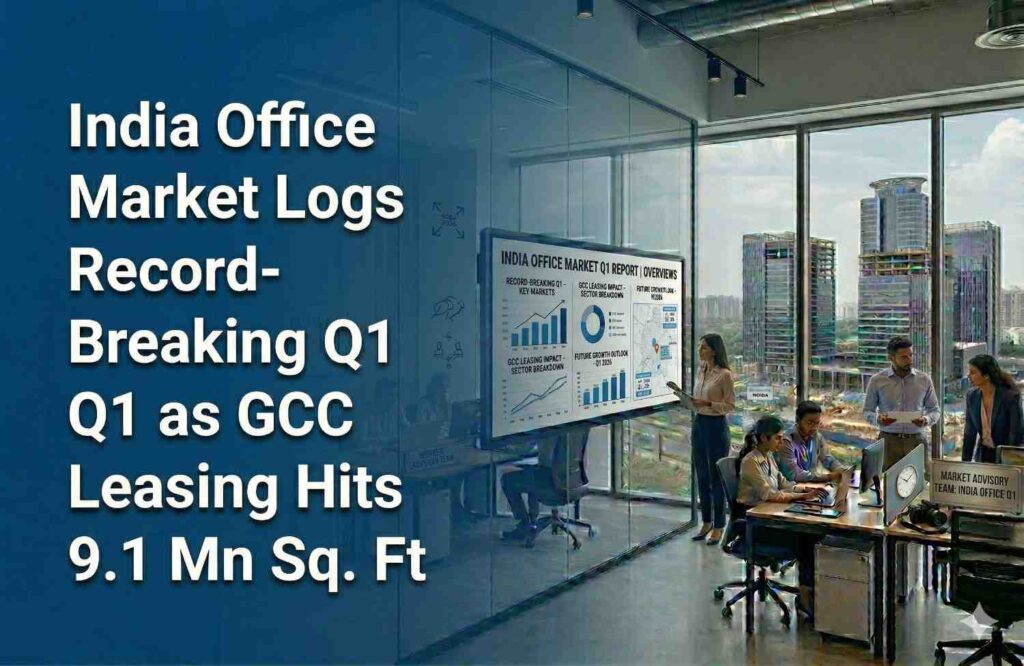
India’s office market recorded its strongest-ever Q1 in 2026, with total leasing reaching 20.7 million sq. ft. GCCs drove 44% of demand, leasing a record 9.1 million sq. ft. Bengaluru led activity, while flex spaces and sustainable buildings gained traction, signalling a structural shift in occupier preferences.
India’s commercial office sector has entered 2026 on a powerful note, recording its strongest first quarter ever. Total office leasing reached approximately 20.7 million square feet during January–March, up 5% from the same period last year.
At the centre of this growth are Global Capability Centres (GCCs), which have emerged as the dominant force shaping demand. GCCs alone leased a record 9.1 million square feet during the quarter—the highest-ever quarterly absorption by this segment.
This surge reflects growing confidence among global corporations in India as a long-term destination for high-value operations.
GCCs Take the Lead
GCCs accounted for 44% of total office leasing in Q1, underlining their expanding influence in India’s commercial real estate landscape. A significant portion of this demand came from American companies, which contributed nearly 73% of total GCC leasing activity.
The demand was also well diversified across sectors. E-commerce led with a 24% share, followed by BFSI and technology at 20% each, while research, consulting, and analytics contributed 19%.
Industry experts noted, “The record leasing highlights India’s emergence as a preferred global hub for high-value capability functions.” This shift indicates that GCCs are no longer limited to support roles but are evolving into strategic centres handling core business functions.
Rise of Mid-Market and Agile GCCs
A notable trend this quarter is the growing presence of mid-sized and smaller GCCs. These emerging players are increasingly setting up operations focused on digital engineering, fintech, SaaS, and advanced analytics.
At the same time, smaller or “nano” GCCs are acting as agile innovation hubs, particularly in AI and niche research. These companies often opt for managed, flexible workspace formats, allowing them to scale quickly without a heavy upfront investment.
This diversification is expanding the occupier base and boosting demand across both premium office assets and flexible workspace environments.
Bengaluru Leads, Premium Assets in Demand
Bengaluru continued to dominate the office market, accounting for 48% of total GCC leasing activity. Hyderabad followed with a 19% share, while Delhi-NCR captured 14%.
Across the broader office market, Bengaluru also led with a 29% share of total leasing, followed by Delhi-NCR and Mumbai. Together, these three cities accounted for nearly two-thirds of overall demand.
Occupiers showed a clear preference for high-quality spaces. Around 83% of GCC leasing was concentrated in green-certified tech parks, while nearly 78% of transactions were in buildings less than 10 years old. This trend highlights the growing importance of sustainability, infrastructure quality, and employee experience.
Flex Spaces and Tech Firms Drive Activity
Flexible workspace operators and technology companies together contributed nearly 40% of total leasing activity. Domestic firms played a major role in driving demand for flex spaces, while global corporations dominated leasing in technology and BFSI sectors.
This growing reliance on flexible offices reflects a shift toward agile real estate strategies. Companies are increasingly prioritising speed, scalability, and cost efficiency, making flex operators a key part of the office ecosystem.
Industry leaders observed that occupier demand is becoming more diversified, with a strong preference for “amenity-rich, sustainable workplaces.”
Outlook: Sustained Momentum Ahead
Looking forward, India’s office market is expected to maintain its growth trajectory. Total office stock is projected to cross 1 billion square feet in 2026, supported by new supply in major cities such as Bengaluru, Hyderabad, and Delhi-NCR.
GCCs are likely to continue expanding aggressively, with many established centres taking up large spaces exceeding 100,000 square feet in premium developments.
The strong start to 2026 suggests that India’s office market is not just growing—it is evolving. With GCCs, flexible workspaces, and sustainability at the forefront, the sector is entering a new phase of structured, long-term expansion.