
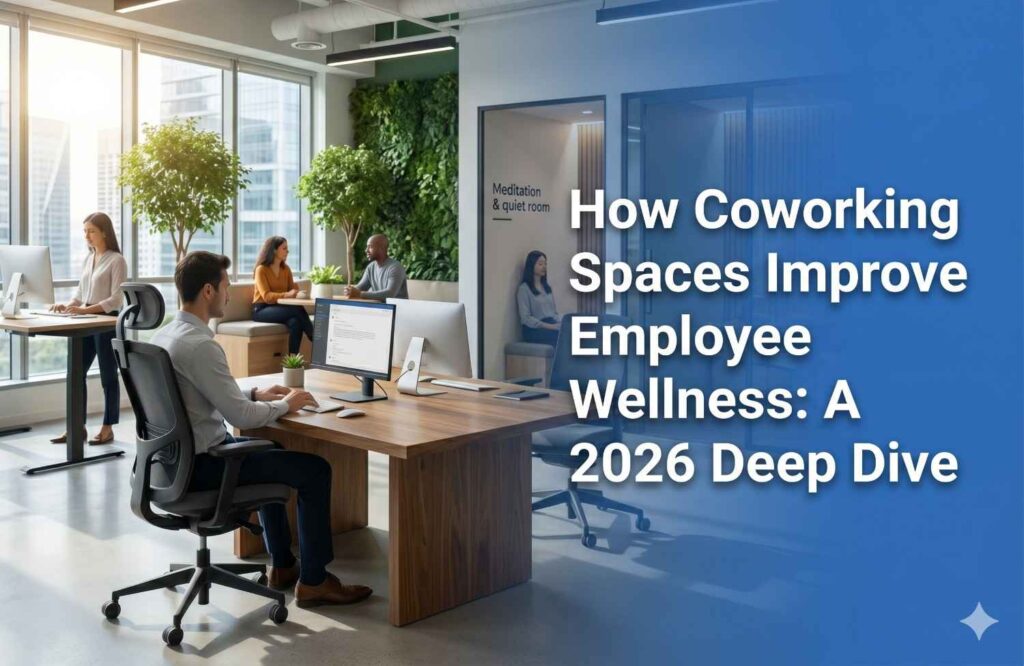
Discover how 2026 coworking spaces have transitioned from flexible desks to vital wellness infrastructures. This deep dive explores “ambient belonging,” biophilic design, and cognitive zones that combat isolation and burnout. Learn why shared environments outperform home and traditional offices by prioritising mental health and professional autonomy for sustainable performance.
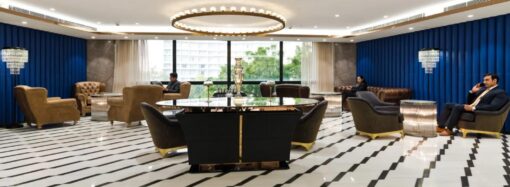
If you still think coworking spaces are just about flexible desks and artisanal coffee, you are looking at an outdated model. The modern coworking environment has evolved into something far more strategic: a wellness infrastructure for the high-performance knowledge worker.
Organisations and individuals are no longer optimising only for productivity. They are optimising for sustainable performance, which is directly tied to mental health, physical well-being, and social fulfilment.
Coworking spaces are quietly outperforming both traditional corporate offices and the isolation of home setups. Here is the deep dive into why these spaces have become the new standard for employee wellness.
Solving the Loneliness Epidemic with “Ambient Belonging”
One of the most underestimated workplace risks today is professional isolation. While hybrid work created the flexibility you craved, it also triggered a silent crisis.
Coworking spaces offer a unique psychological solution called “Ambient Belonging.”
- Low-Stakes Social Capital: You are surrounded by people, but without the “forced fun” of corporate icebreakers. Social engagement is optional, allowing you to absorb the energy of a crowd without the pressure to perform.
- Hierarchical Freedom: Unlike in a traditional office, where every chat feels monitored by a manager, coworking interactions are peer-to-peer. This reduces social anxiety and emotional fatigue.
- With 65% of remote workers reporting loneliness as a major challenge, coworking spaces are increasingly seen as a solution to restore social interaction and reduce isolation.
By providing a neuro-social regulator, where human presence stabilises your mood, coworking acts as a natural antidote to the burnout caused by digital-only interaction.
Designing for Cognitive Energy, Not Just Seating Capacity
Traditional offices optimise for “heads per square foot.” In contrast, the top coworking spaces of 2026 optimise for cognitive performance cycles.
Humans naturally function in ultradian rhythms: 90-120-minute cycles of high focus followed by a need for mental recovery. Coworking spaces are architected to support this:
- Activity-Based Neighbourhoods: You can move from a silent “Library Zone” for deep work to a “Social Lounge” for ideation, and finally to a “Recharge Pod” for recovery.
- Sensory Intentionality: Many coworking spaces use “Nervous-system-first design,” featuring curved circulation and acoustic zoning that naturally slows your breathing and reduces cortisol levels after intense meetings.
Instead of forcing you to adapt to a static desk, the environment adapts to your mental state. This flexibility reduces cognitive overload and ensures you leave work with energy left for your personal life.
“Passive Wellness”: Health by Design
Most corporate wellness programs fail because they require extra effort; you have to decide to go to the company gym. Coworking spaces solve this by embedding wellness into the physical environment.
- Biophilic Dominance: Around 60% of coworking spaces now explicitly integrate biophilic design. This includes indoor forests, air quality sensors, and even the use of “phytoncides” (natural oils from trees) to lower blood pressure and boost immunity.
- Movement-Friendly Layouts: Designers are now creating “long looping routes” and varied perch points that gently nudge you to move throughout the day.
- Ergonomics as Standard: In 2026, features like standing desks and circadian lighting, which sharpen focus in the morning and wind you down in the afternoon, are no longer premium upgrades; they are the baseline.
The Insight: Environment-driven habits always outperform intention-driven habits. You don’t need the discipline to be healthy when the building does the work for you.
Comparative Wellness Matrix Snapshot
| Wellness Driver | Working from Home | Traditional Office | Modern Coworking |
| Social Regulation | Isolated | Hierarchical/High-Pressure | Ambient/Low-Pressure |
| Cognitive Variety | Low (Same 4 walls) | Moderate (Static desks) | High (Zoned for tasks) |
| Work-Life Boundary | Collapsed | Rigid/Commute-heavy | Psychological “Clutch” |
| Access to Nature | Variable | Usually Low | High (Biophilic Standard) |
| Autonomy | High (but lonely) | Low | Maximum |
Restoring the Psychological “Work-Life” Boundary
One of the greatest wellness challenges you face today is boundary collapse. When your kitchen table is your office, your brain never truly “shuts off.” This leads to chronic stress and poor sleep quality.
Coworking spaces reintroduce spatial separation.
- The Ritual of Transition: The act of “going to” a coworking space signals your brain to enter professional mode. Leaving the space serves as a psychological “off-switch.”
- Home as a Sanctuary: By moving work to a dedicated office space, your home regains its identity as a recovery zone.
Autonomy: The Ultimate Stress Reliever
Autonomy is the strongest predictor of workplace satisfaction. Traditional offices often strip this away through fixed seating and rigid schedules.
In a coworking ecosystem, you are the CEO of your environment. You choose your light level, your noise level, and your social proximity. This sense of control is deeply therapeutic; when you have the “choice of refuge,” your brain’s amygdala (the stress centre) remains calm.
Micro-Recovery and the Prevention of Burnout
Burnout isn’t the result of one hard day; it’s the result of 500 days without a “reset.” Modern coworking spaces prevent this accumulation by normalising rest.
In 2026, we are seeing a rise in “Experiential Spaces” over “amenities for show.”
- Meditation Pods & Nap Zones: These aren’t just for naps; they are for “Non-Sleep Deep Rest” (NSDR), which resets cognitive function.
- Curated Wellness: From on-site physiotherapists to sound-bath rooms, these spaces integrate professional health services into your workday.
- The Benefit: Taking a 10-minute micro-break in a specialised recovery zone can improve the quality of your decision-making.
The Diversity Dividend and “Weak Ties”
Wellness is also about the quality of your professional identity. When you work at a corporate office, you are an “employee.” When you work in a coworking space, you are a member of a diverse ecosystem.
Interacting with “weak ties”, acquaintances from different industries, expands your perspective and increases emotional resilience. This cross-pollination reduces the feeling of career stagnation and boosts optimism. You aren’t just a cog in a machine; you are an active participant in a thriving professional community.
Final Words
The most important takeaway in 2026 is this: Coworking spaces are no longer competing with offices; they are replacing them as wellness-first platforms.
As the workforce shifts toward prioritising “human energy” over “hours logged,” the architecture of where you work becomes your most important health tool. By choosing a coworking environment, you are choosing a system that supports your biology rather than one that fights it.
Ask yourself: Is your current workspace a “drain” or a “recharge”? If you’re feeling the weight of the digital grind, the solution might not be a vacation; it might just be a better desk in a better ecosystem.





















Leave a Comment
You must be logged in to post a comment.