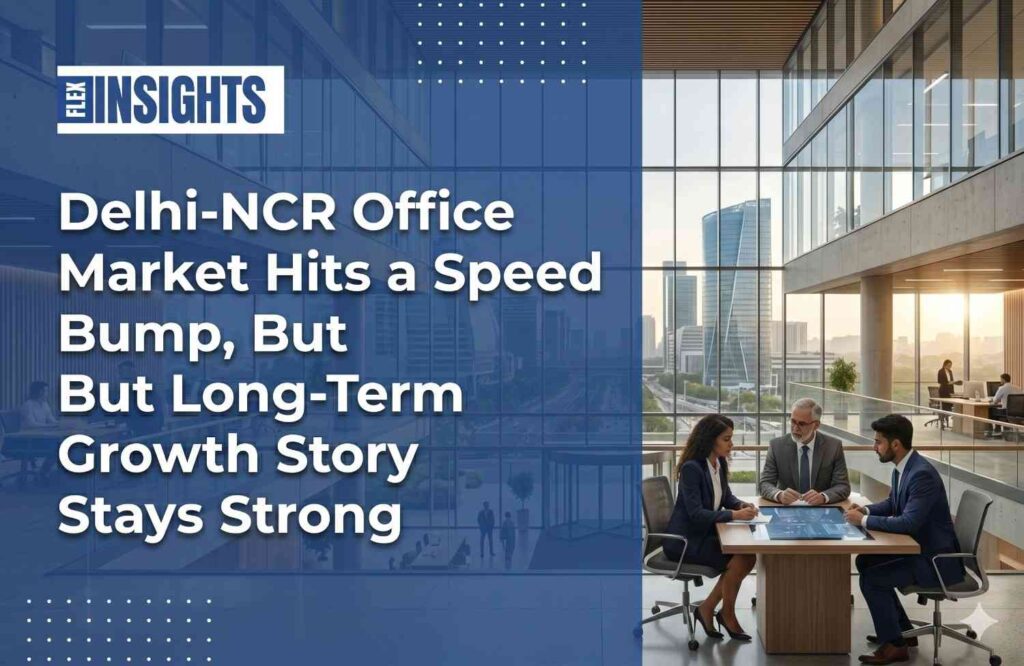
Delhi-NCR’s office leasing dropped sharply in Q1 due to lower supply, with net absorption down 60%. However, strong demand from global firms, upcoming mega projects, and falling vacancy rates across India signal resilience. Experts believe the market is shifting toward high-quality, flexible workspaces despite a short-term slowdown and evolving occupier needs.
Delhi-NCR’s office market witnessed a noticeable slowdown in the first quarter, with leasing activity taking a hit due to limited new supply. Net absorption dropped sharply by 60% to 1.5 million sq ft, while gross leasing declined 28% year-on-year to 3 million sq ft.
This dip was largely driven by a steep decline in fresh supply, which fell to 1.39 million sq ft from 2.9 million sq ft in the same period last year. With fewer Grade A developments entering the market, occupiers had limited options, directly impacting deal volumes.
Understanding the Numbers: Gross vs Net Leasing
While gross leasing includes all transactions such as pre-commitments, net absorption reflects actual occupied space after accounting for vacated areas. This distinction highlights that while deals are being signed, physical occupancy is yet to fully catch up—indicating a lag rather than a demand collapse.
Strong Pipeline Signals Future Momentum
Despite the current dip, the region’s long-term outlook remains positive. Major developers are doubling down on commercial real estate. Large-scale projects, including a Rs 7,500 crore commercial development in Gurugram, are set to add significant Grade A office and mixed-use space in the coming years.
Established players like DLF, Bharti Realty, and Max Estates continue to strengthen their portfolios, while new developments in Noida and Gurugram are expected to boost supply and revive leasing momentum.
Pan-India Market Tells a Different Story
Interestingly, the broader Indian office market paints a more optimistic picture. Across seven major cities, gross leasing rose 10% to 21.5 million sq ft, while net absorption grew 7% to 13.7 million sq ft.
This growth is largely fueled by global companies setting up Global Capability Centres (GCCs), reinforcing India’s position as a strategic hub for innovation and operations. As one industry leader noted, “Market fundamentals continue to strengthen, with pan-India vacancy dropping to a five-year low of 14.7 per cent.”
Structural Shift in Workplace Demand
Experts believe the market is undergoing a deeper transformation rather than a cyclical slowdown. “We believe India’s office market is in the middle of a genuine structural shift, not just another cycle,” said Vibhor Jain.
He added that while demand remains strong, external factors like geopolitical tensions and rising costs could influence decision-making. At the same time, AI-driven changes in work models are reducing dependency on large headcount-based office spaces.
The Rise of Quality-Driven, Flexible Workspaces
The evolving landscape is pushing developers and operators toward creating smarter, more flexible environments. “The opportunity now is to build the right quality of workplace for a more selective and evolving occupier base,” Jain emphasised.
For the coworking and flexible workspace sector, this signals a clear opportunity. As enterprises become more selective, demand will shift toward premium, agile, and experience-driven office solutions—positioning flexibility not as an option, but a necessity.