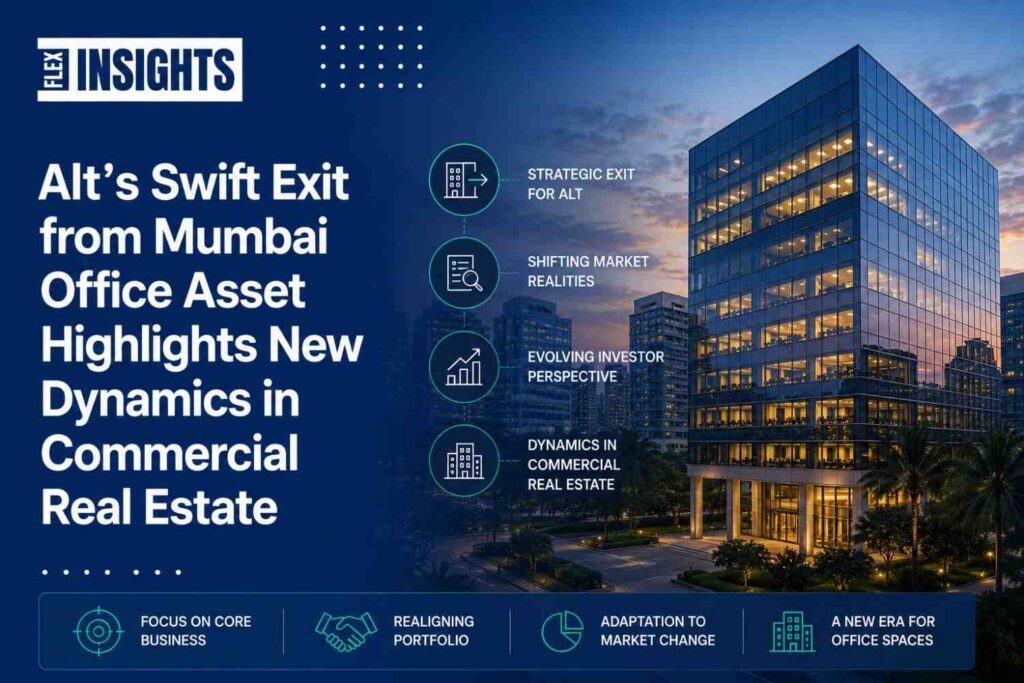
Alternative investment firm Alt has exited Mumbai’s GCorp Tech Park after just nine months. The deal underscores rising institutional demand for Grade-A office assets and widening valuation differences between private and institutional investors. Industry observers see the transaction as a sign of evolving commercial real estate investment strategies across India.
India’s commercial real estate sector is witnessing a shift in how office assets are being bought, held, and monetised. Alternative investment platform Alt has exited its investment in Mumbai’s GCorp Tech Park after a holding period of only nine months, achieving an impressive 103% internal rate of return (IRR). The transaction is attracting attention because it demonstrates how premium office assets are increasingly being viewed as high-liquidity investment opportunities rather than traditional long-term holdings.
The deal highlights what many industry participants see as a growing valuation gap between institutional investors and individual capital providers. By acquiring the asset at one valuation level and exiting at a significantly higher one, Alt benefited from strong demand for Grade-A office properties among institutional buyers. According to market observers, “The realised gains from the GCorp Tech Park divestment underscore a tactical exploitation of market inefficiencies currently present within Indian Grade-A office real estate.” The outcome reflects how sophisticated investors are in identifying opportunities in segments where pricing expectations vary widely across buyer groups.
Institutional Capital Drives Asset Repricing
The property’s location along Mumbai’s Ghodbunder Road corridor played a key role in its appreciation. Improved connectivity prospects, upcoming metro infrastructure, and sustainability-focused building credentials have strengthened investor confidence in the micro-market. These factors continue to increase the attractiveness of commercial office assets in emerging business districts beyond traditional central business hubs.
Industry experts note that the ownership transition from private investment capital to large institutional and REIT-linked investors represents a broader market evolution. As noted in the market assessment, “The transition of ownership from private equity to large-scale REIT-linked schemes illustrates the ongoing institutionalisation of Thane’s commercial micro-market.” Institutional investors are increasingly prioritising assets with strong tenant profiles, stable occupancy, and long-term leasing commitments. In the case of GCorp Tech Park, established occupiers and quality infrastructure enhanced the asset’s appeal among large-scale buyers.
Opportunities Come with New Risks
While the transaction showcases the potential of short-term commercial real estate investments, analysts caution that such returns may not always be easy to replicate. Rapid appreciation strategies depend heavily on sustained demand from institutional investors, family offices, and REIT-backed vehicles willing to acquire premium office assets at higher valuations.
Market experts warn that any slowdown in office leasing activity, changes in interest rates, or rising vacancy levels could impact future transaction volumes and pricing. Additionally, investors may face challenges identifying similar opportunities as more high-quality assets become absorbed into institutional portfolios. This could push some market participants toward higher-risk investment strategies in search of comparable returns.
What It Means for the Flexible Workspace Industry
For the broader flexible workspace and office sector, the deal reinforces the growing value of well-located, professionally managed commercial assets. As institutional capital continues to flow into premium office developments, asset quality, tenant strength, sustainability credentials, and connectivity will become even more critical drivers of valuation.
Alt’s successful exit may signal increased secondary-market activity in commercial real estate. However, as regulatory scrutiny of emerging investment structures intensifies, the sector is entering a more mature phase where disciplined asset selection and long-term fundamentals will remain essential for sustained growth.