
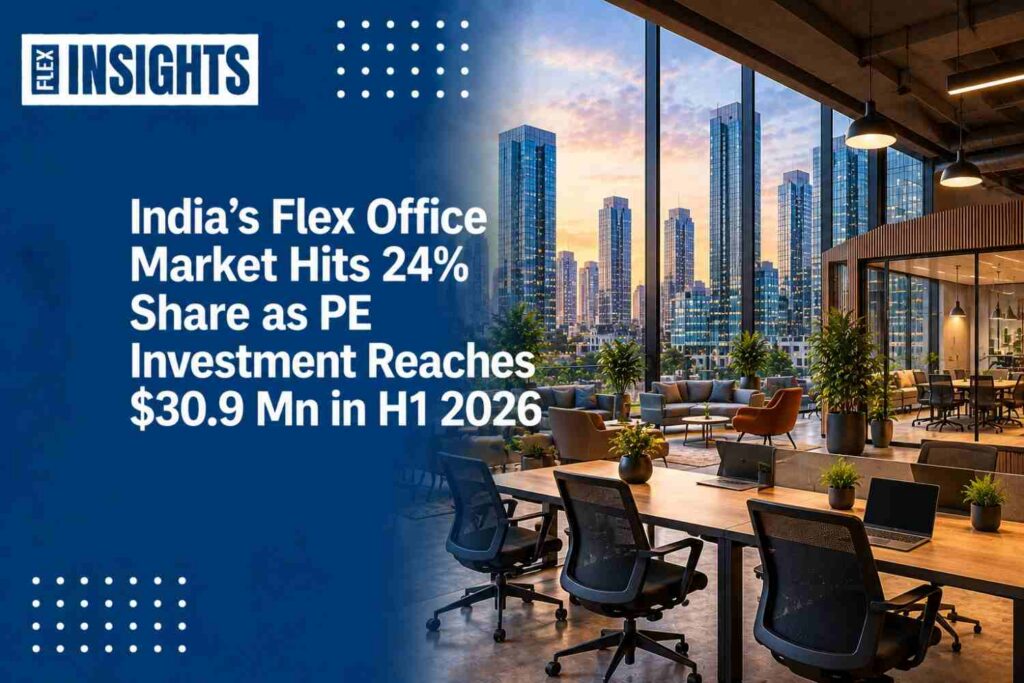
India’s flexible office market is gaining momentum, with flex space accounting for 24% of office absorption in H1 2026. PE investment reached $30.9 million across two deals, exceeding the full-year 2025 figure. Large enterprises accounted for 72% of flex seats, while GCCs accounted for 52% of demand.
India’s flexible office sector is becoming a larger part of the commercial real estate market, with flex space accounting for 24% of total office absorption across the top eight cities in H1 2026. The share has climbed sharply from just 4% in H1 2017, showing how workspace flexibility has moved from a niche offering toward a more established occupier strategy.
Flex leasing reached 11.4 million sq ft during the first half of 2026. Overall office absorption across the leading eight cities stood at 48 million sq ft, putting flexible workspace firmly at the centre of the country’s evolving office market.
PE Investment Crosses 2025 Full-Year Level
Investor interest is also showing signs of recovery. Private equity investment in India’s flex office sector reached $30.9 million across two deals in H1 2026, already exceeding the $24.3 million invested in 2025.
Investment in the segment has moved through several cycles. Capital deployment rose from $25.3 million in 2017 to $112.3 million in 2019 before the pandemic disrupted activity. The sector recorded its largest annual inflow in 2022, attracting $594.5 million across nine deals.
Investment later moderated to $59.4 million in 2023, $31.1 million in 2024 and $24.3 million in 2025. According to Knight Frank India, the larger-ticket transactions recorded in H1 2026 could point to renewed momentum in capital deployment.
Enterprises and GCCs Drive Flex Demand
Demand has expanded alongside investment. Flex transactions grew from 2.2 million sq ft in 2017 to 18.6 million sq ft in 2025, representing a 30% compound annual growth rate.
Bengaluru led flex office absorption in H1 2026 with 2.9 million sq ft, followed by Pune and NCR at 2.2 million sq ft each. Hyderabad added another 2 million sq ft.
The occupier mix is also changing. Large enterprises now account for 72% of flex seats, marking a clear shift from the segment’s earlier association with freelancers, startups and smaller businesses. Global Capability Centres contributed 52% of flex demand, underlining the growing role of flexible workspace in enterprise expansion and location strategy.
Market Moves Towards Scale and Consolidation
Knight Frank India says the sector is moving away from operator proliferation toward scale and consolidation, with investors increasingly assessing enterprise exposure, operational capability and scalability.
For occupiers, the appeal lies in adjusting workspace commitments as business requirements change. The model allows companies to “convert fixed real estate commitments into variable capacity,” according to Viral Desai of Knight Frank India.
This shift is strengthening the position of flex space within corporate real estate portfolios. With enterprise adoption rising, GCC demand expanding and investment showing renewed interest, flexible offices are increasingly being treated as a structural component of India’s workplace strategy rather than a temporary response to changing work patterns.

























Leave a Comment
You must be logged in to post a comment.