
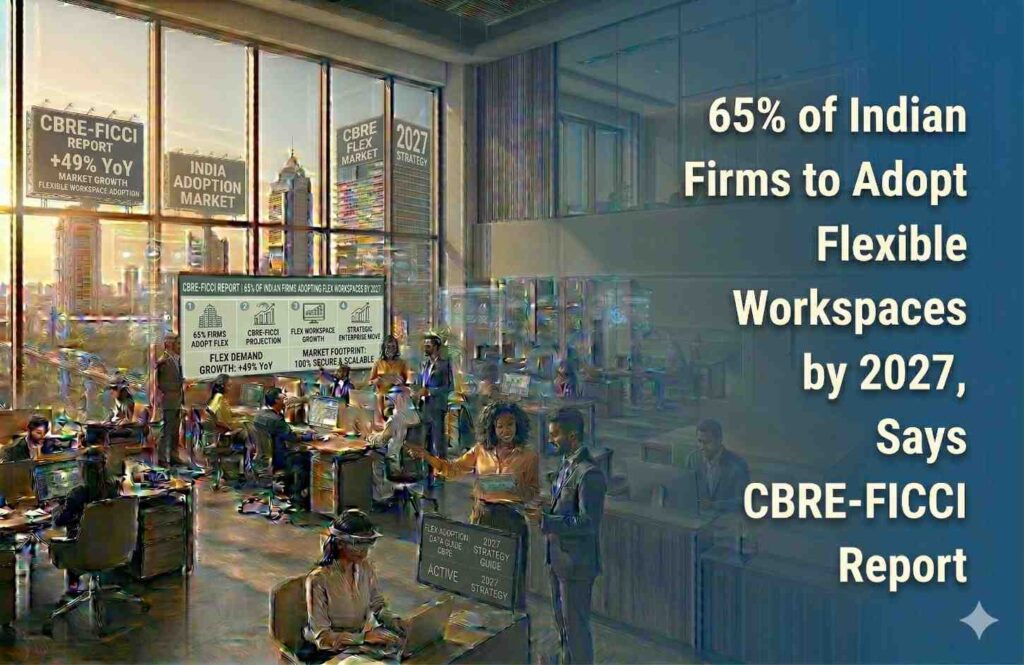
A joint report by CBRE India and FICCI reveals that nearly 65% of Indian firms plan to adopt flexible workspaces by 2027. This shift is being driven by strong enterprise demand, rapid supply expansion across key cities, positioning flex offices as a core pillar of India’s evolving office market strategy.
Flexible workspaces are no longer a secondary option in India’s office market—they are becoming a core component of corporate real estate strategies. According to a new report by CBRE India in collaboration with FICCI, nearly 65% of office occupiers in India expect to include flexible workspaces in their portfolios by 2027. Already, 55% of companies have incorporated flex into their office mix.
The report notes, “Flex is no longer treated as a temporary fix, an overflow option or a start-up convenience.” Instead, it is now embedded into long-term portfolio planning as companies seek agility, efficiency, and faster go-to-market capabilities.
A Decade of Rapid Transformation
India’s flexible workspace sector has evolved significantly over the past decade. What began as a fragmented ecosystem of coworking hubs has transformed into a mature, enterprise-grade offering serving multinational corporations, global capability centres (GCCs), and MSMEs.
The scale of this growth is striking. Between 2020 and 2025, flexible workspace stock expanded nearly threefold. By 2025, total stock reached approximately 110–114 million sq. ft., accounting for 10–12% of India’s overall office inventory. Notably, nearly half of this supply has been added since 2021, reflecting strong post-pandemic momentum.
Demand Driven by Agility and Expansion
The surge in flex adoption is being driven by a shift in occupier behaviour. Companies are leveraging flexible workspaces not just for cost savings, but for strategic advantages—such as entering new markets quickly, managing variable headcounts, and testing locations without long-term lease commitments.
As the report highlights, “Flexibility has moved from an add-on to an embedded part of office strategy.” This shift underscores how enterprises are prioritising optionality and scalability in an uncertain business environment.
Tier-I Cities Lead, but Dynamics Vary
The flexible workspace market remains heavily concentrated in Tier-I cities, which account for over 90% of total stock. Bengaluru leads with 30–32 million sq. ft., followed by Delhi NCR with 21–23 million sq. ft.
However, Pune stands out for its high penetration rate of 14–16%, indicating deeper adoption within its office market. Meanwhile, Mumbai is witnessing strong demand from BFSI firms and large corporates, signalling growing acceptance among traditional occupiers.
Enterprise Demand Reshapes the Sector
A key trend shaping the next phase of growth is the rise of enterprise-led demand. Flexible workspaces are increasingly being used as satellite offices, project hubs, and even long-term managed solutions. This marks a clear shift from the earlier perception of flex as a startup-driven segment.
Large enterprises and GCCs are now driving demand for customised, high-quality office environments with enterprise-grade services, compliance, and technology integration.
Institutional Capital Fuels the Next Phase
The sector is also attracting increasing interest from institutional investors. Public listings by major operators have pushed the market capitalisation of listed flexible workspace firms to an estimated $2.0–2.2 billion.
This influx of capital is expected to bring greater discipline, scalability, and standardisation to the market. As a result, flexible workspaces are transitioning from a fragmented model to a more structured and resilient segment within India’s office ecosystem.
The Road Ahead: A Defining Shift
As India’s office market continues to evolve, flexible workspaces are set to play a defining role. With nearly two-thirds of occupiers planning to adopt flex by 2027, the segment is no longer operating on the sidelines.
Instead, it is becoming one of the primary ways the office market functions—reshaping how companies lease, design, and use workspace in a more agile, future-ready environment.