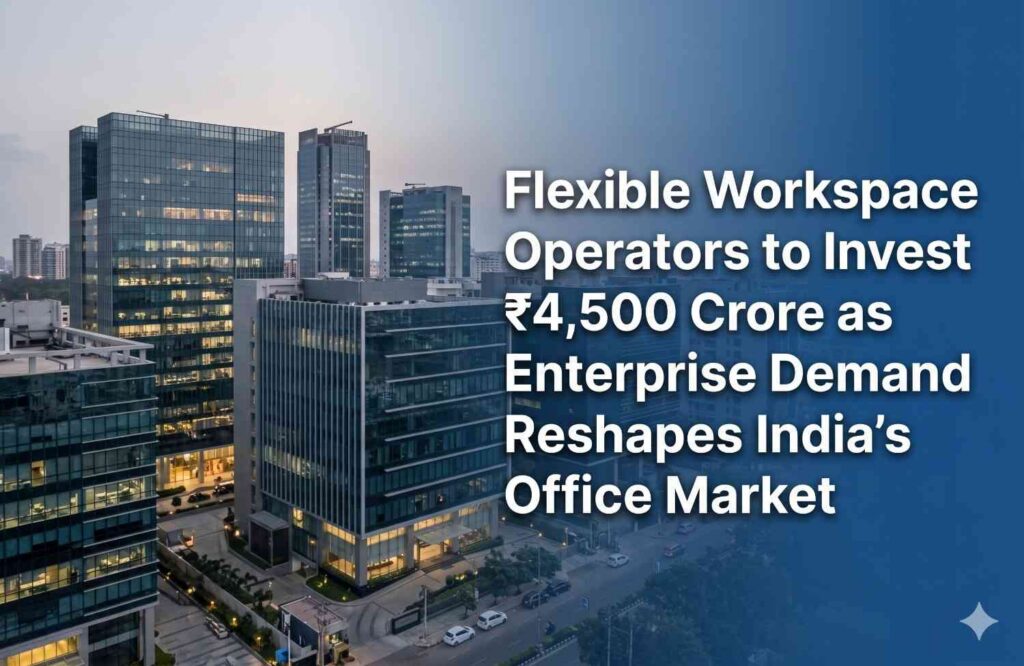
India’s leading flexible workspace operators are expected to invest ₹4,000-4,500 crore to add 15-20 million sq ft of new capacity over the next two financial years. The expansion is being driven by strong enterprise and GCC demand, with flex workspaces projected to account for nearly 25% of office absorption in the coming years.
India’s flexible workspace industry is preparing for another major expansion cycle as leading operators plan investments of ₹4,000-4,500 crore to scale managed office portfolios across major cities and emerging business hubs. According to a recent report by Crisil Ratings, the planned capital expenditure is expected to support the addition of nearly 15-20 million square feet of new workspace capacity over the current and upcoming financial years.
The report estimates that India’s total flexible workspace stock could rise to around 140-145 million sq ft during this period, reflecting annual growth of 16-18%. This builds on the sector’s already strong momentum, which saw a compound annual growth rate of nearly 23% over the past three financial years. The current flex workspace inventory across the country stands at approximately 100-105 million sq ft.
The latest projections highlight how managed office solutions are steadily moving from an alternative workplace format to a mainstream commercial real estate strategy for large occupiers.
Enterprise and GCC Demand Continue to Fuel Expansion
The rapid growth of the flexible office sector is being driven largely by enterprise occupiers and Global Capability Centres (GCCs), which are increasingly adopting managed office models to support expansion while maintaining operational flexibility.
Flexible workspace offerings typically provide fully serviced office environments with furnished workstations, shared amenities, technology infrastructure, and operator-managed services under flexible leasing arrangements. This model is becoming particularly attractive for companies seeking to reduce upfront capital expenditure, optimise occupancy costs, and scale operations faster than traditional office leasing models allow.
Industry participants noted that GCC growth, distributed workforce strategies, and rising demand for proximity-based workspaces are accelerating adoption across both metro cities and emerging commercial districts.
Flex Operators Gain Larger Share of Office Absorption
Crisil Ratings highlighted that flexible workspace operators are now becoming a major contributor to India’s overall commercial office absorption. Their share in net office leasing has increased from around 14-15% in FY24 to an estimated 20% in FY26.
The report further projects that flex operators could account for nearly 25% of office absorption over the next two financial years, reflecting a structural transformation in occupier behaviour and corporate real estate planning.
This shift is also changing how businesses approach workplace infrastructure. Instead of committing to long-term conventional leases with heavy fit-out costs, many enterprises are now prioritising agile, managed office ecosystems that can quickly adapt to changing workforce requirements.
Expansion Moves Beyond Traditional Metro Markets
The analysis covered six major flexible workspace operators, which together accounted for nearly half of India’s total flex office capacity at the end of the previous calendar year. Several operators are now actively expanding into newer micro-markets and Tier-II cities as demand broadens geographically.
Industry experts believe this diversification strategy is helping operators tap into rising regional business activity while reducing concentration risks tied to a few major urban centres.
Despite aggressive expansion plans, Crisil noted that leverage levels across leading operators are expected to remain stable. Strong recurring cash flows and improving occupancy levels are likely to fund a significant portion of future investments, reducing dependence on external debt financing.
The report ultimately signals a larger structural shift in India’s office market, where flexible workspace formats are increasingly becoming a core part of enterprise real estate strategy rather than a supplementary workplace solution.