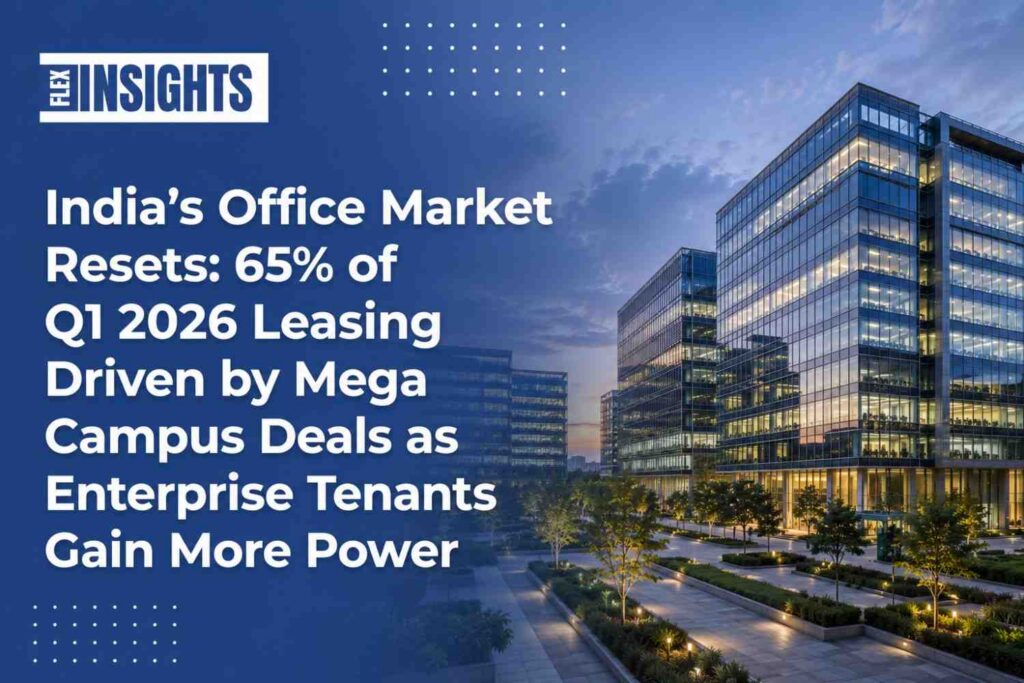
India’s commercial office market is rapidly shifting toward integrated campus-style workplaces. Large office deals reached 19.5 million square feet in Q1 2026, representing 65% of total leasing activity. Strong demand from GCCs and multinational corporations is boosting tenant bargaining power while pressuring developers to provide premium, ESG-compliant, future-ready office infrastructure.
India’s commercial real estate sector is rapidly evolving as large corporations increasingly move toward consolidated, campus-style office environments designed for operational efficiency, employee experience, and long-term scalability. The shift is significantly altering leasing patterns across major business cities and changing how developers approach future office supply.
According to recent market data, large office transactions accounted for nearly 19.5 million square feet in Q1 2026, representing around 65% of all leasing activity during the quarter. The growth in large-format office leasing underscores occupiers’ clear preference for integrated campuses over fragmented office setups spread across multiple locations.
This transformation is being driven primarily by Global Capability Centres (GCCs), technology firms, multinational corporations, and financial services companies seeking modern office ecosystems that support collaboration, flexibility, and business expansion.
Bengaluru, Hyderabad, and Mumbai Lead Large Office Demand
Bengaluru continued to dominate India’s large office leasing market, recording approximately 7 million sq ft of large-format transactions during the quarter. Hyderabad and Mumbai also witnessed sharp growth in enterprise leasing activity.
Hyderabad’s large office leasing surged 69% year-on-year to 4.4 million sq ft, while Mumbai recorded an 81% annual increase, reaching nearly 2.9 million sq ft in major office transactions. Mid-sized leasing activity also remained healthy, rising 27% to around 5.2 million sq ft.
The data indicates that enterprises are increasingly prioritising large, scalable campuses capable of supporting hybrid work models, centralised operations, and long-term workforce expansion.
Tenant Expectations Shift Beyond Traditional Office Space
Occupiers today are no longer simply leasing square footage. Instead, they are seeking highly customised, ESG-compliant workplaces equipped with premium amenities, wellness infrastructure, sustainability certifications, and strong connectivity.
This has shifted bargaining power significantly toward tenants, especially large enterprises capable of signing long-term, high-value leases. Developers are now under growing pressure to deliver Grade A campuses that meet evolving workplace standards around sustainability, flexibility, and employee experience.
The demand for LEED-certified and ESG-compliant office assets is accelerating as corporations integrate sustainability goals into their real estate strategies. Rental growth for Grade A office assets averaged between 7% and 9% across key Indian cities in 2025, though experts note that future growth will increasingly depend on building quality and infrastructure standards.
Older Office Buildings Face Rising Obsolescence Risk
While the consolidation trend is benefiting premium office developers, it is creating new challenges for older commercial properties that lack modern amenities or sustainability compliance. Industry analysts warn that several Grade B and Grade C office assets could face declining demand as occupiers gravitate toward newer integrated developments.
Buildings without strong connectivity, advanced workplace infrastructure, or ESG credentials may require significant capital upgrades to remain competitive. At the same time, stronger tenant leverage could place pressure on developer margins, particularly for landlords operating ageing office portfolios.
Despite ongoing discussions about hybrid work and space optimisation, companies continue to view premium office campuses as strategic tools for productivity, talent retention, and operational efficiency.
Premium Office Demand Expected to Stay Strong
Analysts expect demand for high-quality office infrastructure to remain resilient through 2026, supported by continued GCC expansion, multinational investments, and enterprise consolidation strategies. Infrastructure improvements, urban transit connectivity, and access to talent pools are also expected to remain critical factors influencing future leasing activity.
As India’s office market matures, the focus is steadily shifting from traditional office supply toward flexible, sustainable, and experience-driven workplace ecosystems tailored for enterprise growth.