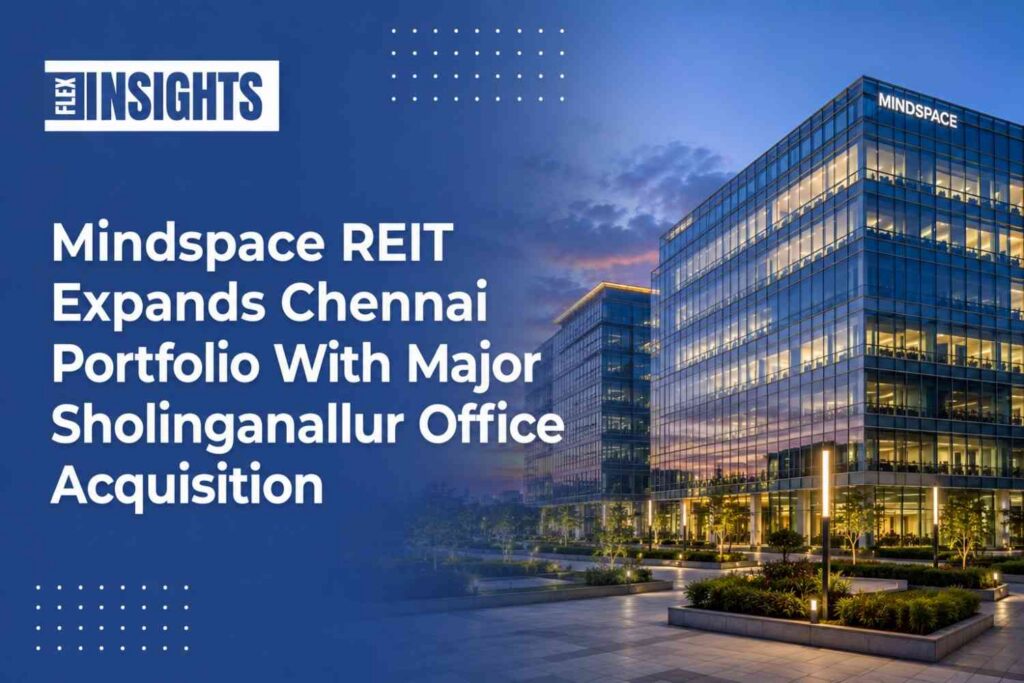
Mindspace Business Parks REIT has expanded its Chennai portfolio by acquiring commercial office assets in Sholinganallur, adding nearly 25 lakh sq ft of chargeable office space. The deal strengthens Chennai’s growing position in India’s office leasing market while highlighting rising institutional investment, GCC demand, and increasing focus on sustainable urban infrastructure.
Mindspace Business Parks REIT has strengthened its footprint in Chennai through the acquisition of two major commercial property entities located in the city’s rapidly growing Sholinganallur technology corridor. The transaction adds nearly 25 lakh square feet of chargeable office space to the REIT’s portfolio, reinforcing institutional confidence in Chennai’s long-term office market growth.
The acquisition was completed through a preferential allotment of REIT units rather than a direct cash transaction. According to market filings, the assets are located in Pallikaranai village within the Sholinganallur belt, one of Chennai’s fastest-expanding commercial and technology districts.
The portfolio includes both completed office developments and an under-construction commercial tower, indicating the REIT’s strategy to balance stabilised rental assets with future growth opportunities.
Chennai Continues to Attract Institutional Real Estate Capital
The latest transaction reflects a broader trend of rising institutional investment in Chennai’s office market, particularly across the city’s southern IT corridor.
Industry observers believe Chennai is increasingly attracting commercial real estate investment due to relatively lower land costs compared to Bengaluru and Hyderabad, along with improving infrastructure connectivity and strong demand from Global Capability Centres (GCCs).
Urban development analysts noted that “Chennai’s peripheral IT corridors are increasingly attracting institutional capital” because of expanding technology activity and large-format office campus availability.
Sholinganallur, in particular, has emerged as a major office destination over the last decade, supported by technology parks, infrastructure upgrades, and rising enterprise leasing demand.
The corridor continues to attract occupiers from the technology, engineering, consulting, and back-office sectors seeking scalable office environments and cost-efficient operations.
REIT Strategy Focuses on Long-Term Growth
The acquisition also demonstrates how REIT-backed office platforms are increasingly focusing on future leasing cycles rather than relying solely on fully stabilised income-generating assets.
By including under-construction commercial inventory within the portfolio, Mindspace REIT appears to be positioning itself to capture future occupier demand as India’s office market evolves over the coming years.
Market experts believe the completed office stock could begin generating rental income relatively quickly if occupancy levels remain healthy. However, revenue contribution from the under-construction tower may depend on construction timelines, tenant fit-outs, and future leasing momentum.
At the same time, the preferential allotment structure has drawn attention from minority investors monitoring ownership dilution and governance practices within listed REIT structures.
Analysts noted that while such acquisitions can strengthen portfolio scale and improve long-term rental potential, investors often evaluate factors such as valuation transparency, occupancy assumptions, and leverage levels before assessing the long-term impact on public unitholders.
Hybrid Work and GCC Demand Continue Shaping Leasing Trends
Despite the ongoing influence of hybrid work models on office utilisation strategies, Chennai’s office market has remained relatively resilient, driven by strong demand for large-format campuses and operational cost advantages.
Industry experts tracking the Chennai office market stated that future absorption of the newly acquired office inventory will depend heavily on continued demand from technology firms, engineering companies, and GCC occupiers over the next 12 to 24 months.
As multinational corporations continue expanding operations in India, Chennai’s role as a strategic commercial destination is expected to strengthen further.
Infrastructure and Sustainability Become Critical for Future Growth
The expansion of institutional office development across Sholinganallur also highlights growing concerns around urban infrastructure and sustainability.
Urban planners have cautioned that rapid commercial growth in the corridor could increase pressure on transport systems, groundwater availability, flood management infrastructure, and ecologically sensitive marshland areas.
Experts argue that future commercial expansion in Chennai’s southern corridor will require stronger integration of public transport, climate-sensitive planning, and flood-mitigation systems to ensure that infrastructure development keeps pace with rising office demand.
As REIT-backed office expansion accelerates across India, the Chennai transaction reflects both the opportunities and challenges shaping the future of urban commercial real estate.