
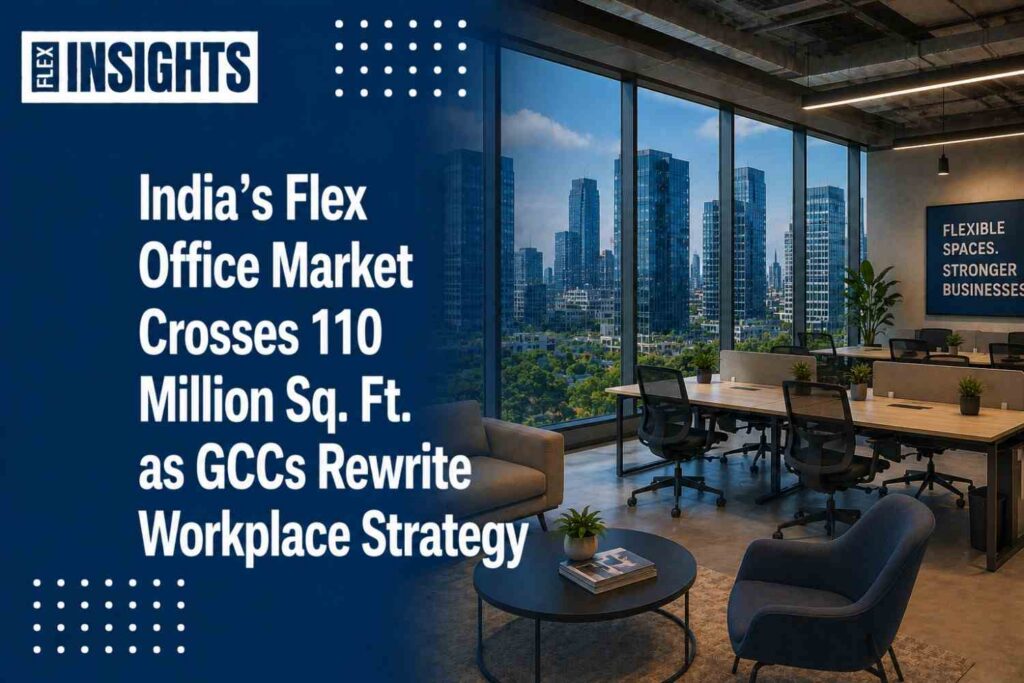
India’s flexible office inventory has crossed 110 million sq. ft., more than tripling since 2020. GCCs drove 44% of Q1 2026 office leasing, while 67% plan to increase flex adoption. Bengaluru leads the market, and AI could create another 79 million sq. ft. of office demand by 2030.
India’s flexible workspace sector is entering a new stage of growth, with total inventory crossing 110 million sq. ft., more than three times its 2020 level. What began largely as coworking for startups and freelancers is increasingly becoming a strategic real estate option for large enterprises and Global Capability Centres (GCCs).
The shift is being driven by a simple corporate need: speed without heavy upfront commitments. GCCs can use managed and flexible offices to enter new markets, expand teams and adjust capacity without waiting for conventional office fit-outs or locking themselves into long leases. The sector now accounts for around 10-12% of Grade A office stock, underscoring how far flex has moved into the mainstream.
GCCs Are Changing the Demand Equation
GCCs have become one of the strongest engines of India’s flexible office demand. They accounted for 44% of India’s record 20.7 million sq. ft. of office leasing in Q1 2026, while a reported 67% of GCCs plan to increase their use of flexible workspaces. The preference reflects a broader shift in workplace strategy, with companies seeking scalable, enterprise-grade environments rather than treating flex as temporary overflow space.
The shift is also reflected in industry commentary. CBRE India Chairman and CEO Anshuman Magazine said, “Flex is now a core component of how India’s leading companies plan and manage their real estate portfolios.” He noted that occupiers have moved beyond experimenting with flex and are integrating it into longer-term portfolio planning.
Bengaluru Leads as Operators Scale Up
Bengaluru remains India’s largest flexible workspace market, accounting for around 31% of Grade A flex stock. Delhi-NCR is another major enterprise hub, supported by strong demand from technology, BFSI, and professional services companies.
Operators are responding by expanding capacity and moving toward larger managed-office formats. WeWork India has reportedly locked in 36% capacity growth for FY27, while BuzzWorks has doubled its inventory to nearly 15,000 seats. The trend shows that competition is increasingly shifting from basic coworking amenities to scale, building quality, technology infrastructure and the ability to deliver multi-city enterprise mandates.
AI Could Add Another Demand Wave
The next major catalyst could come from artificial intelligence. Redseer estimates that AI-led growth could generate nearly 79 million sq. ft. of additional office demand in India by 2030, as enterprises expand AI, engineering, data and specialised technology teams.
For flex operators, this could be significant because AI-driven teams often scale quickly and require highly collaborative, technology-rich workplaces. The emerging “core plus flex” model allows companies to retain a stable corporate footprint while adding flexible capacity as headcount and projects change.
India’s flex market is therefore moving from a volume-growth story to an enterprise real estate story. As GCCs expand, AI reshapes workforce requirements, and companies prioritise agility, flexible workspace providers could become an increasingly important part of how India’s office market is planned, leased and operated.

























Leave a Comment
You must be logged in to post a comment.