
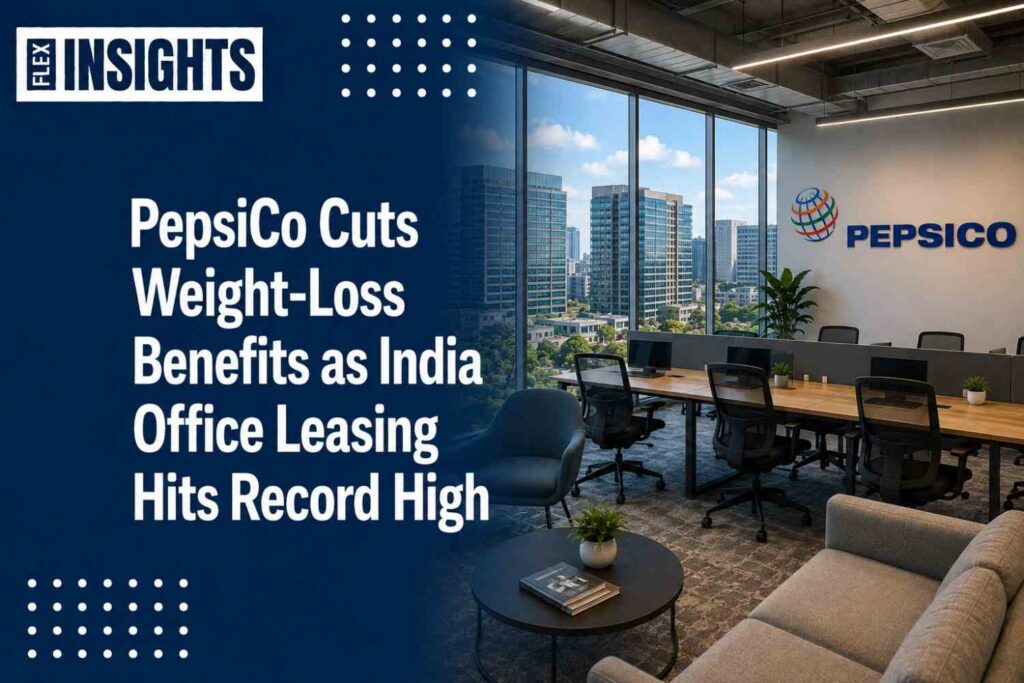
PepsiCo will end insurance coverage for weight-loss drugs from October as employers focus on controlling healthcare costs. At the same time, India’s office market reached a record 24.6 million sq. ft. of leasing. Strong expansion plans and rising occupier demand point to continued momentum for developers and REITs.
PepsiCo’s decision to stop covering weight-loss medications under its employee health insurance plans from October highlights a growing challenge for large employers: managing the rising cost of GLP-1 drugs. These medicines have been rapidly adopted because of their effectiveness in treating obesity and related health conditions, but their growing use is putting pressure on corporate healthcare budgets.
For HR and finance teams, the issue is increasingly becoming one of cost sustainability. Companies are reviewing expensive prescription benefits more closely as they seek to control operating expenses. The move also has broader implications for PepsiCo and other food and beverage companies, as changing consumer eating habits could eventually affect demand for calorie-heavy, processed products.
India’s Office Market Breaks New Ground
While some global companies are tightening spending, India’s commercial real estate market is showing strong expansion. Gross office leasing reached a record 24.6 million square feet in Q2 2026, according to the data provided. Leasing increased 18% from the previous quarter and 14% from a year earlier, pointing to resilient demand for physical workplaces despite wider economic uncertainty.
The numbers suggest that companies are not simply maintaining their existing footprints. Many are actively expanding and consolidating operations, creating fresh opportunities for landlords, developers and flexible workspace operators. For the Indian office sector, this continued occupier activity is an important signal that demand for quality workplaces remains healthy.
Companies Plan Bigger Real Estate Footprints
The outlook becomes even stronger when looking beyond quarterly leasing figures. A CBRE South Asia survey found that 75% of companies operating in India plan to increase their real estate footprint by 2028. Around 30% of respondents want to expand their office portfolios by more than 30%.
For the flex and managed office industry, this could translate into greater demand for scalable workspace solutions. Businesses seeking flexibility as they grow may increasingly turn to managed offices, coworking spaces and flexible lease structures instead of committing entirely to traditional long-term leases.
Landlords Face the Next Test
Strong leasing does not remove the risks facing commercial real estate investors. Developers still need to deliver projects on time and control construction costs, while landlords must watch for potential oversupply in aggressively developed micro-markets.
Rental growth will therefore be a key metric to track in the coming quarters. The ability to convert strong occupier demand into higher rents and sustainable asset performance will matter to developers and REITs alike.
The contrast between PepsiCo’s healthcare cost-cutting and India’s office expansion captures two very different corporate trends. While businesses in some markets are focused on reducing overheads, Indian companies are continuing to invest in space for growth. For the flexible office sector, that expansion could create a particularly attractive runway as occupiers balance growth with the need for agility.























Leave a Comment
You must be logged in to post a comment.