
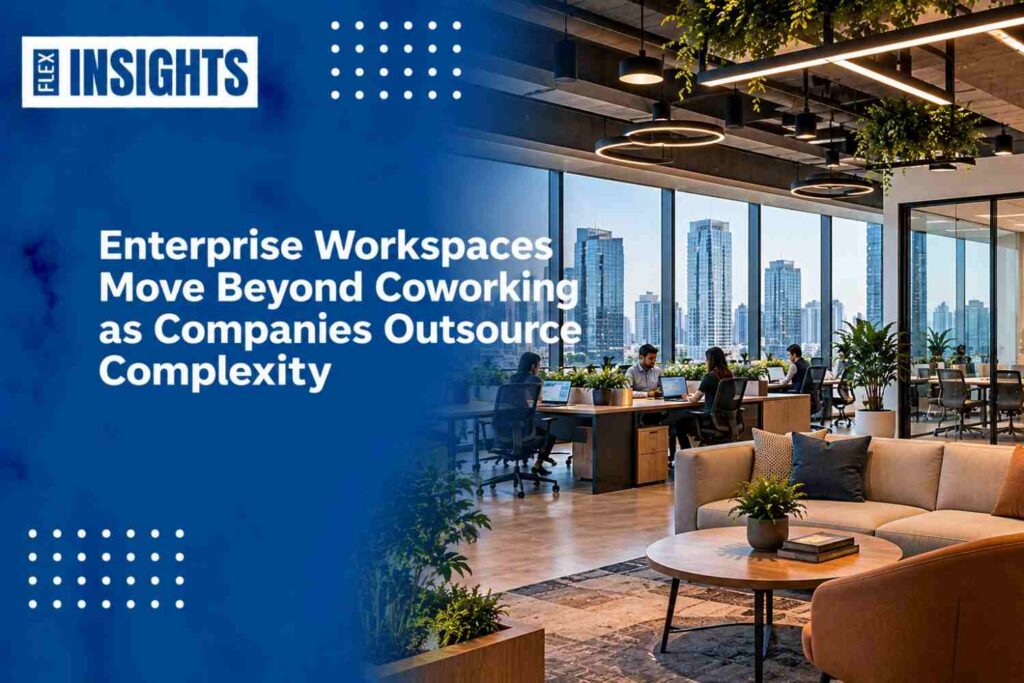
Enterprise workplace demand is shifting from traditional coworking towards managed workspace models that combine real estate, design, technology, operations and employee experience. Table Space President and Co-CEO Kunal Mehra highlights repeat enterprise demand, global capability, AI-led operations and hospitality as key factors shaping the next phase of the managed office market.
The enterprise workspace market is moving beyond the traditional idea of coworking, according to Kunal Mehra, President and Co-CEO of Table Space. For large companies, the requirement is increasingly about managing the full workplace lifecycle rather than simply accessing office desks.
Enterprise occupiers may need workplaces built around their brand, technology, security, compliance and employee standards. That makes the role of a managed workspace provider broader, covering real estate, design, fit-outs, procurement, project delivery, IT, facilities and day-to-day operations.
Mehra describes the shift simply: “Enterprises are not outsourcing control. They are outsourcing complexity.”
The approach is particularly relevant for companies expanding across cities or markets, where managing multiple workplace functions internally can require significant capital and management resources.
Repeat Business Becomes a Key Measure
Table Space’s enterprise-focused model is reflected in its client base. As of March 31, 2026, the company served 431 unique clients, including 45 Fortune 500 companies and 115 GCCs. GCC clients accounted for more than half of its leased area.
However, Mehra points to repeat business as a stronger indicator of enterprise relationships. In FY26, 56.77% of new area leased came from existing clients, compared with 29.88% in FY24.
“The first transaction tells you an enterprise is willing to use the model. The second transaction tells you whether the model worked,” he said.
For managed workspace operators, this puts greater emphasis on consistent delivery across buildings, cities and multiple workplace requirements.
Global Clients Push Workplace Platforms Further
Table Space also has significant exposure to international companies. As of March 31, 2026, US-headquartered clients accounted for 55.49% of its leased area. The company has therefore established a business development presence in the US to build relationships and better understand clients’ real estate requirements earlier.
Its expansion into the Philippines through KMC adds another layer. The combined India and Philippines platforms represent approximately 13 million sq ft under management. KMC also offers services such as Employer of Record, recruitment, payroll, compliance and IT support.
This reflects a wider enterprise requirement in which workplace decisions are linked to market entry, hiring, compliance, and scaling rather than to property alone.
Technology and Experience Become Differentiators
Mehra says technology will have greater value when it improves actual workplace decisions. Table Space uses data and AI across market intelligence, design, capex planning, project delivery and facility operations.
The company is also placing greater emphasis on workplace experience. While security, infrastructure and facilities remain essential, hospitality, service, food, meetings and employee support can shape how a workplace is perceived.
Mehra says, “Operations make the workplace dependable. Experience makes it distinctive.”
He identifies four capabilities likely to shape enterprise workplace platforms: relationship depth, operating intelligence, experience and global capability. The focus, he argues, will increasingly move away from centre count and square footage towards how much workplace complexity a platform can absorb and how consistently it can deliver across markets.



















Leave a Comment
You must be logged in to post a comment.