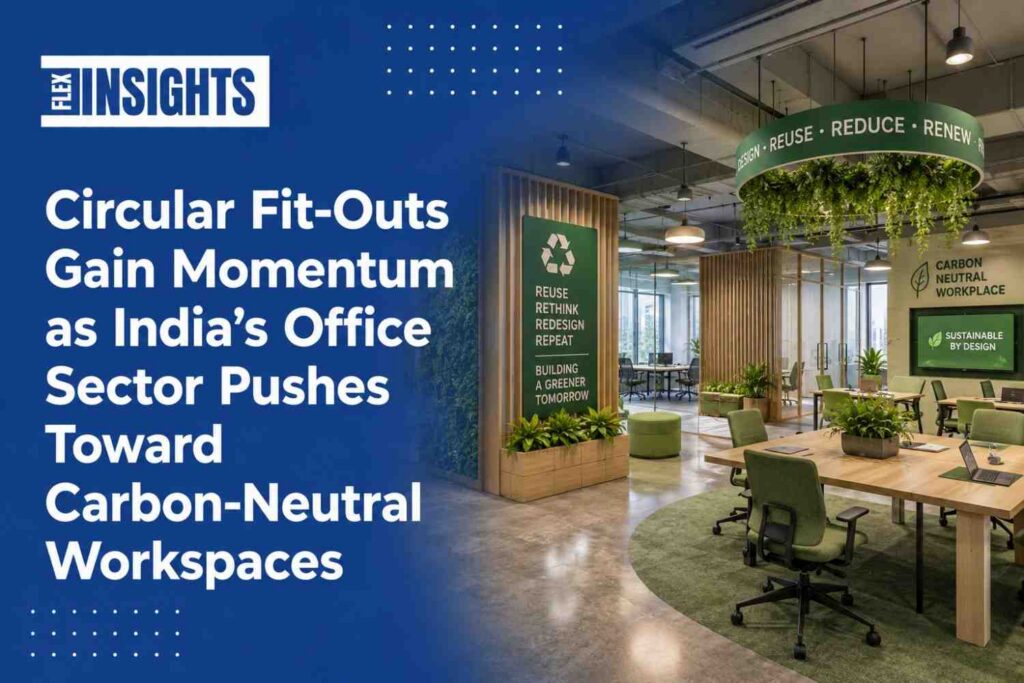
India’s commercial office market is witnessing a major shift toward sustainable workplace interiors as corporates adopt circular fit-outs and low-carbon materials. Experts say green office interiors can reduce embodied carbon emissions by up to 55%, improve long-term asset value, support ESG goals, and create future-ready workspaces across Grade-A and flexible office developments.
India’s commercial real estate sector is rapidly moving beyond green-certified buildings and focusing on what happens inside office spaces. As occupiers increase investments in sustainability, companies are now prioritising circular office interiors, reusable materials, and low-carbon fit-outs to support long-term ESG commitments and carbon-neutral workplace goals.
The shift comes at a time when office leasing activity across India’s top cities continues to grow strongly. Office leasing crossed 75 million sq. ft. in 2025, recording a CAGR of 19% since 2020. While this growth highlights rising demand for Grade-A workplaces and flexible offices, it has also intensified concerns around material waste and embodied carbon generated through frequent office refurbishments.
Industry experts say fit-outs are becoming one of the most resource-intensive parts of commercial real estate, especially as workplaces are redesigned every five to seven years to accommodate hybrid work models, changing occupier needs, and shorter lease cycles.
Circular Fit-Outs Become a Strategic Priority
According to Savills India, circular fit-out strategies offer a practical solution by encouraging the reuse of materials, reducing lifecycle emissions, and creating more adaptable workplaces. The model focuses on designing interiors that minimise waste while improving long-term operational efficiency.
“When embedded into project planning from the outset, circular interiors can significantly reduce lifecycle costs, programme risk, and material waste,” said Sumit Rakshit, Managing Director, Project Management Services, Savills India.
Savills added that circular fit-outs could reduce embodied carbon emissions by 25–55%, helping companies align with stricter ESG targets while improving asset resilience. Although these solutions may require a 10–15% higher upfront investment, experts believe businesses can recover costs over five to ten years through lower replacement expenses and reduced waste generation.
Grade-A Offices and Flex Spaces Lead Adoption
The trend is gaining traction across premium office developments, managed workspaces, and flexible office operators, where sustainability is becoming a key differentiator. Developers are increasingly seeing demand for interiors made using recycled or reusable materials, energy-efficient systems, and modular workplace designs.
“As India’s office landscape continues to evolve, the way interiors are designed and delivered requires a fundamental rethink,” said Arvind Nandan, Managing Director, Research and Consulting, Savills India.
Industry leaders believe occupiers are no longer viewing sustainability as an optional feature. Instead, it is becoming closely linked to employee experience, operational efficiency, investor expectations, and long-term business resilience.
Landlords See Rental Premium Potential
Experts also believe sustainable office interiors may soon influence leasing decisions and rental values across India’s commercial market. According to Savills India, lower-carbon interiors could command higher rental premiums as companies increasingly seek future-ready work environments.
“Over the next 5-7 years, circular and low-embodied-carbon fit-outs are likely to become standard in Grade-A and flexible offices,” said Shruti Singh, Co-founder and Director, Operations at Carbon Guardians.
She added that early-moving landlords could benefit from stronger differentiation, reduced downtime, and lower lifecycle risks. However, broader adoption will depend on policy support, ecosystem maturity, and industry-wide collaboration.
With India’s commercial real estate sector continuing to expand, sustainability-focused workplace design is expected to play a much larger role in shaping the next generation of offices. For developers, coworking operators, and enterprise occupiers, circular interiors are increasingly emerging as both an environmental responsibility and a long-term business strategy.