
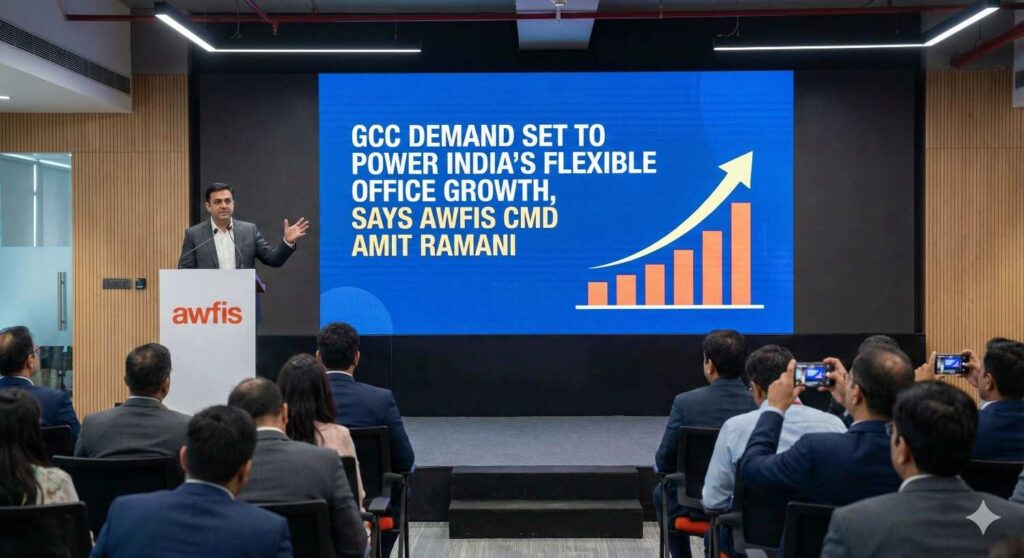
Global Capability Centres are emerging as the strongest growth engine for India’s flexible and managed office market. Awfis CMD Amit Ramani says GCCs already dominate large enterprise demand, favour longer tenures and higher margins, and are accelerating the adoption of managed offices as first-time global entrants scale operations across India.
Demand from Global Capability Centres (GCCs) is reshaping India’s flexible and managed office space landscape, positioning the segment for sustained long-term growth. According to Amit Ramani, Chairman and Managing Director of Awfis Space Solutions, large enterprises now account for the bulk of demand for flexible offices, with GCCs holding a dominant share in this segment. “Large corporate enterprises account for about 65% of our total demand, and of that, roughly 70% plus today is GCC,” he said.
Managed Offices Gain Preference
Ramani noted that flexibility, execution speed, and cost efficiency are key reasons for GCCs’ shift toward managed office solutions. Companies are increasingly opting for plug-and-play spaces that let them start small and scale quickly as teams grow. Integrated services such as security, IT infrastructure, and facility management further reduce operational complexity. “30% of all GCCs coming to India are first-time centres,” he said, adding that many lack internal real estate teams, making managed offices a faster and simpler entry route.
Longer Tenures and Better Margins
From a commercial standpoint, GCC-led demand is also proving more attractive for operators. Ramani highlighted that GCC contracts typically have longer lock-in periods than those for smaller clients. While the average tenure across Awfis’ portfolio is around 33 months, GCC agreements typically extend beyond 3 years. He also pointed to stronger profitability, noting that margins for GCC clients generally range from 30% to 40%, depending on scale and service requirements.
Pipeline Momentum Remains Strong
The pace of GCC expansion into India shows no signs of slowing. Over the past nine months, more than 50 GCCs have entered the country, with 12 choosing Awfis for their workspace needs. Ramani said the market is adding 25 to 30 new GCCs every quarter, many of them first-time entrants. “We anticipate doing about 25 to 30% of all GCC demand that comes to India,” he said, underlining Awfis’ ambition to capture a significant share of this fast-growing segment.
Financial Outlook Reflects Confidence
The growing GCC footprint is also feeding into Awfis’ financial outlook. Ramani shared that the company closed FY25 with revenue of around ₹1,200 crore and is targeting over ₹1,500 crore in FY26, translating into roughly 30% growth. EBITDA margins are expected to remain stable, with guidance of around 14% under IGAAP and 36–37% under IndAS, reflecting operational discipline despite rapid expansion.
Industry-Wide Impact
Beyond Awfis, Ramani expects GCCs to account for 50–60% of the industry’s overall demand for flexible office spaces in the coming years. As multinational firms continue to consolidate operations in India and adopt hybrid-friendly, scalable office models, managed and flexible workspaces are likely to play a central role. While Awfis’ stock has seen pressure over the past year, the company’s GCC-led strategy signals strong confidence in the long-term fundamentals of India’s flex office market.