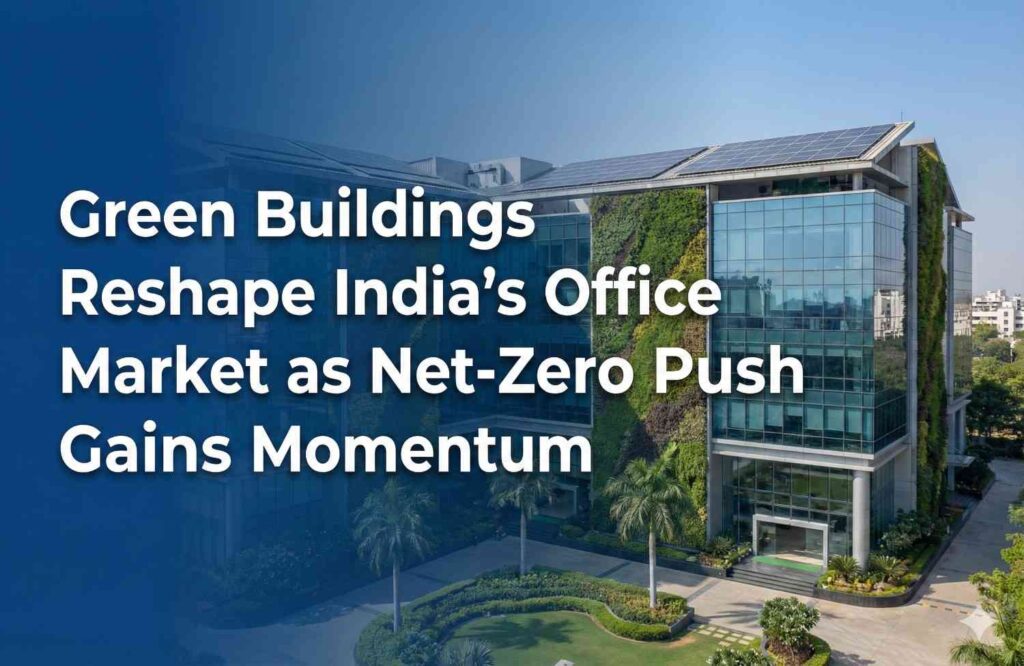
India’s green building movement is accelerating as developers adopt sustainable construction to align with net-zero goals. Rising ESG demand, rental premiums for green-certified offices, and expanding eco-material markets are driving change. Industry reports show strong growth in sustainable infrastructure across commercial and residential sectors, especially in Grade-A office and flexible workspace developments.
India’s real estate sector is undergoing a structural transformation as sustainability becomes a central theme across commercial and residential developments. With the country targeting net-zero emissions by 2070 and a 45% reduction in carbon intensity by 2030, developers are increasingly integrating green construction practices at the design stage itself. According to a recent report cited by The Times of India, builders are actively seeking pre-certifications to ensure compliance with stricter environmental standards.
This shift is particularly visible in Grade-A office assets and flexible workspace developments, where occupiers are prioritising energy efficiency, wellness-focused interiors, and ESG-aligned infrastructure.
Green Materials Market Expands Rapidly
A joint report by KPMG and the National Real Estate Development Council highlights strong momentum in India’s green building materials ecosystem. The segment is currently growing at an annual rate of 10–12% and is projected to reach a market valuation between ₹6.2 lakh crore and ₹7 lakh crore by 2030. The growth is being driven by rising environmental awareness and increasing demand for sustainable office environments.
Corporate occupiers are also influencing this trend as workplace strategies evolve toward long-term sustainability goals. Modern office tenants now evaluate environmental impact across the entire lifecycle of a property rather than focusing only on construction quality.
ESG Expectations Reshape Workplace Design
Industry experts note that sustainability is no longer limited to structural design but is extending into interiors and operational systems. Vibhor Jain, Founder and CEO of Carbon Guardians, emphasised this transition, stating, “The focus is now extending beyond construction to what goes inside these spaces. Workplaces today are expected to feature stable materials and healthier air systems from day one. Sustainable interiors have shifted from being desirable to being indispensable, as businesses look for spaces aligning with their ESG goals.”
This trend is especially relevant for coworking operators and managed office providers who are increasingly integrating energy-efficient lighting, air-quality monitoring, and recyclable materials to improve tenant experience.
Rental Premiums and Faster Leasing for Green Offices
Market indicators suggest that sustainable assets are delivering clear financial advantages. Green-certified buildings are commanding rental premiums of up to 20% and leasing faster than conventional properties. Nearly all Grade-A office developments in India now carry some form of green certification, reflecting strong institutional adoption.
Experts also expect stricter carbon disclosure norms to emerge in the coming years, with embodied carbon reduction targets already being discussed across commercial projects.
Urbanisation and Infrastructure Driving Long-Term Adoption
According to Parveen Jain, President of the National Real Estate Development Council, the long-term growth of green construction is closely tied to India’s rapid urbanisation. He noted, “As urbanisation gains momentum, the adoption of green construction becomes vital. By 2047, nearly half of India’s population will be living in cities. Green buildings help relieve the strain on urban infrastructure while promoting long-term sustainability.”
In the residential sector, features such as solar rooftops, rainwater harvesting, passive cooling systems, and energy monitoring tools are quickly becoming mainstream rather than optional.
A Defining Shift for Flexible and Future-Ready Workspaces
Although green buildings often require a higher upfront investment, developers and occupiers benefit from lower operational costs, improved asset durability, and stronger occupancy performance. For the flexible workspace sector, sustainability is becoming a competitive differentiator as enterprise clients increasingly demand ESG-compliant environments.
As India moves toward its climate targets, green-certified infrastructure is expected to play a critical role in shaping the next generation of commercial real estate. The industry’s transition suggests that sustainable workplaces are no longer a niche concept—they are becoming the new standard for future-ready office ecosystems.