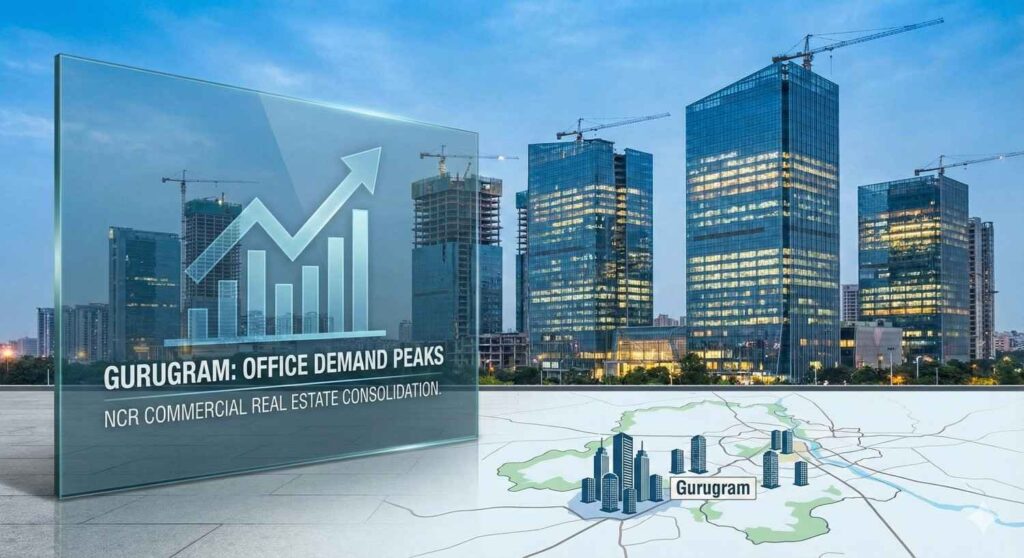
NCR’s commercial real estate market entered a consolidation phase in 2025, led by Gurugram’s strong performance. Record office leasing driven by GCCs, IT firms, and flexible workspace operators, combined with tightening Grade-A retail vacancies, reinforced the city’s position as NCR’s most resilient, scalable, and future-ready commercial real estate hub.
The National Capital Region’s commercial real estate market marked a clear shift in 2025, moving from post-pandemic recovery to consolidation. At the centre of this transition stood Gurugram, which emerged as the region’s strongest growth engine across office and retail segments. Robust occupier confidence, rising absorption, and limited availability of high-quality supply helped the city outperform other NCR markets, positioning it as the most resilient commercial ecosystem in the region.
According to Knight Frank data, Delhi-NCR recorded its highest-ever office leasing of around 7.2 million square feet in the first half of 2025. Gurugram alone accounted for nearly 65% of this absorption, reflecting a sharp increase from the previous year. The demand surge was led by global capability centres, IT services firms, and domestic corporates seeking Grade-A office buildings with modern infrastructure, large floor plates, and strong digital connectivity.
Grade-A Offices and Flex Drive Office Leasing
Office momentum continued through the year. Cushman & Wakefield reported that NCR recorded 5.1 million square feet of gross office leasing in the third quarter of 2025, registering strong quarter-on-quarter and year-on-year growth. Gurugram dominated activity with a 72% share, led by Cyber City and the NH-8 corridor. IT–BPM firms accounted for the largest share of leasing, followed by engineering, manufacturing, and BFSI occupiers.
Industry leaders believe this shift reflects a more strategic approach to office portfolios. Ajay Malik, Chief Strategy Officer at Rise Infraventures, noted that “India’s commercial real estate moved from reaction to strategic planning,” adding that the market now appears “less volatile, more predictable, and ready for long-term capital.” Flexible workspace operators also played a role, supporting occupiers looking for scalability and faster market entry.
Retail Market Tightens as Consumption Returns
Retail real estate mirrored the strength seen in the office market. CBRE data showed organised retail leasing in NCR rose nearly 25% in the first half of 2025, driven by fashion, apparel, and homeware brands. In Gurugram, vacancy levels in Grade-A retail assets fell below 3%, indicating a tightening of supply in prime locations.
Pankaj Jain, Founder and Chairman of SPJ Group, observed that “retail space demand gained traction in micro-markets where residential catchments have matured, but organised retail supply remains limited.” He highlighted how parts of Old Gurugram re-emerged as strong consumption hubs following infrastructure upgrades and improved connectivity.
Experience-Led Retail and Micro-Market Strength
Retail momentum accelerated further in Q3 2025, with leasing touching 0.5 million square feet. Food and beverage operators led demand, accounting for about 40% of leasing, while main streets outperformed malls. Harinder Singh Hora, Founder Chairman of Reach Group, said retail performance is now shaped by “catchment depth, location advantage, visibility, design discipline, and tenant curation rather than format alone.”
Yashank Wason, Managing Director at Royal Green Realty, added that strong office absorption alongside rising organised retail demand “reinforced the importance of well-located, future-ready assets.”
Challenges Ahead Despite Strong Fundamentals
While the outlook remains positive, experts caution against emerging headwinds. Rising land and construction costs, approval delays, infrastructure pressure, and traffic congestion could challenge high-demand micro-markets. Limited Grade-A supply is also pushing rentals upward, testing affordability for some occupiers.
Sachin Gawri, Founder and CEO of Rise Infraventures, summed it up by saying Gurugram’s 2025 performance highlights market maturity, but sustaining momentum will depend on execution, last-mile connectivity, and policy efficiency as the city scales further into 2026.