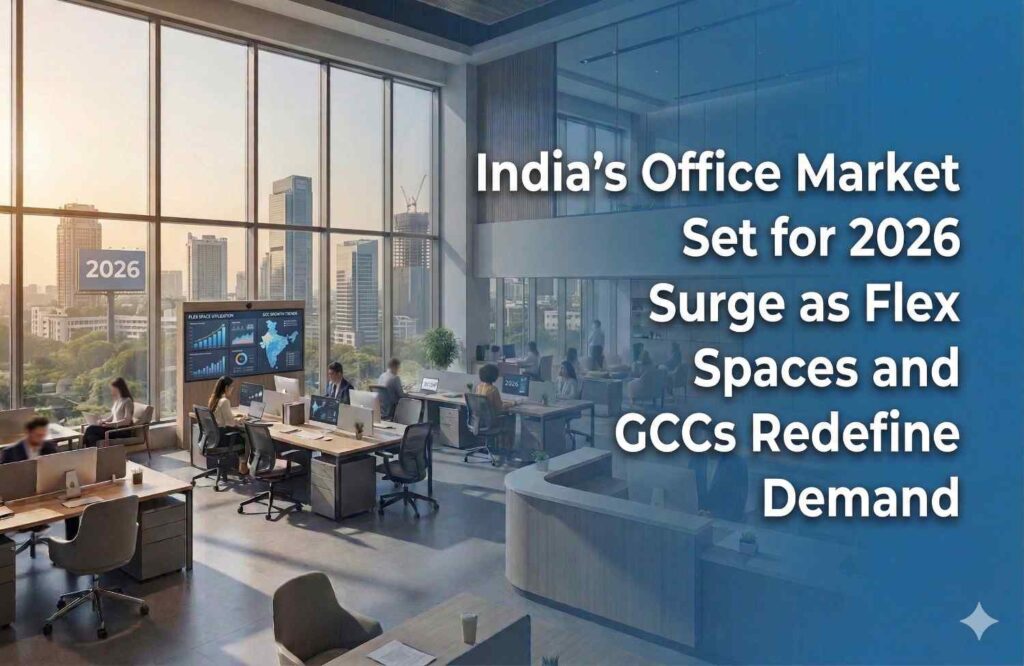
India’s Grade A office market is poised for strong growth in 2026, fueled by GCC expansion, flexible workspace adoption, and REIT-led institutionalisation. Bengaluru leads activity, while sustainability and tech-enabled offices dominate demand. Flex spaces could account for up to 25% of leasing, reshaping occupier strategies nationwide.
India’s Grade A office sector is gearing up for another strong year in 2026, backed by a more diverse occupier mix and evolving workplace strategies. According to Colliers’ report, “2026 India office: Unlocking agility, vitality and flight-to-quality,” the market is being reshaped by flexible work models, technology integration, and sustainability-led development.
This shift reflects a broader transformation where occupiers are prioritising agility and efficiency over traditional long-term commitments. The report highlights that India’s office market is steadily moving toward a more institutionalised and future-ready ecosystem, driven by changing tenant expectations and capital inflows.
GCC Expansion Driving Leasing Momentum
Global Capability Centres (GCCs) are emerging as the primary drivers of demand in the office space segment. No longer limited to back-office operations, these centres have evolved into innovation-led hubs across technology, BFSI, engineering, and manufacturing sectors.
In 2026, GCCs are expected to lease 30–35 million sq ft, accounting for 40–50% of total Grade A demand. Their preference for scalable workspaces, distributed hubs, and flexible leasing models is influencing how developers design and position assets. This trend is also strengthening India’s position as a global hub for business operations.
Flex Spaces Move to the Core of Strategy
Flexible office spaces are no longer a niche segment—they are becoming central to occupier strategies. Companies are increasingly choosing flex solutions to manage costs, scale operations, and support hybrid work models.
Flex operators are projected to lease 15–18 million sq ft in 2026, contributing 20–25% of total leasing activity. India’s flex stock is expected to reach 85–90 million sq ft in 2026 and cross the 100 million sq ft mark by 2027. Beyond space provision, operators are also enabling GCC entry into India through advisory, compliance support, and tech integration.
Key Cities Continue to Anchor Growth
Bengaluru is set to remain the dominant market, contributing nearly one-third of total leasing and supply. Meanwhile, Hyderabad and Delhi-NCR are expected to see strong traction, each adding over 10 million sq ft in demand and new supply.
Other major cities, such as Chennai, Mumbai, Pune, and Kolkata, are likely to maintain steady growth, ensuring balanced expansion across India’s top office markets. This distributed growth pattern signals resilience and depth in the country’s commercial real estate landscape.
REITs and Sustainability Shape the Future
Institutional investment is accelerating, with REIT-led ownership gaining prominence. Around 525 million sq ft of Grade A stock is suitable for REIT inclusion, with significant headroom for future listings. This is improving transparency, asset management standards, and liquidity in the market.
At the same time, sustainability is becoming a key differentiator. Over 80% of new office supply in 2026 is expected to be green-certified, with tech-enabled and ESG-compliant buildings accounting for nearly 80% of leasing. Older assets also present a major retrofit opportunity, unlocking investments worth over INR 500 billion.
As India moves closer to crossing 1 billion sq ft of Grade A office stock by 2030, the market’s evolution signals a clear direction—toward flexibility, sustainability, and long-term value creation.