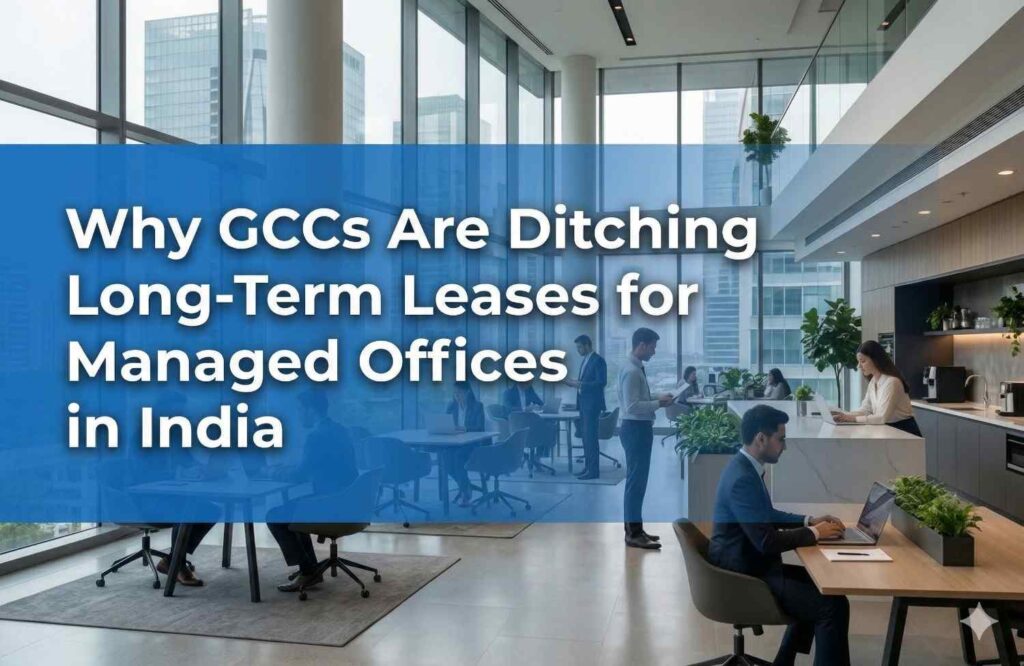
Global Capability Centres (GCCs) in India are shifting from rigid, long-term leases to flexible, managed office spaces. This change prioritises speed and agility, allowing multinational firms to scale rapidly without high upfront costs. By choosing managed spaces, these companies gain modern, move-in-ready hubs that better support innovation and evolving talent needs.
If you closely observe the evolution of India’s commercial real estate market, you will notice that Global Capability Centres (GCCs) have become one of the most powerful demand drivers in the country. Global companies once entered India with traditional office strategies involving long-term leases for large campuses. Today, you can see a different approach emerging.
Many multinational firms are shifting toward managed office spaces instead of committing to rigid, multi-year leases. This transition reflects a bigger strategic change in how global organisations want to operate in India.
When you understand the business logic behind this shift, you realise that flexibility, speed, and operational efficiency have become more valuable than traditional real estate ownership models.
The Limits of the Traditional Long-Term Lease Model
For many years, multinational corporations entering India followed a predictable office strategy. They signed long-term leases ranging from 9 to 15 years for large office campuses in major IT corridors such as Bengaluru, Hyderabad, and Pune.
This approach offered stability, but it also created several operational constraints.
When you commit to long-term leases, you lock capital and operational decisions into fixed infrastructure. In an environment where technology teams scale rapidly, this rigidity can become a challenge.
Consider the realities GCCs face today:
- Workforce sizes change quickly as companies expand digital teams.
- Hybrid work policies influence office utilisation.
- Market expansion may require simultaneous entry into multiple cities.
- Technology projects often scale up and down within months.
These operational dynamics demand workspace models that allow companies to scale faster and adapt to changing workforce needs. As a result, many GCC leaders are rethinking the traditional leasing model and exploring more flexible alternatives.
Surge in Managed Office Space Demand
Managed office spaces have emerged as one of the fastest-growing segments of India’s commercial real estate market. These spaces provide fully operational workplaces, with infrastructure, facility management, and technology support handled by workspace operators.
India now has more than 85 million square feet of flexible office space, with approximately 35 million square feet leased in the past 3 years alone.
For GCCs, this model provides several advantages:
- Faster market entry for new operations
- Shift from CapEx-heavy office investments to an OpEx-based workspace model.
- Scalable seating capacity
- Integrated technology infrastructure
- Simplified operational management
Reports also indicate that GCCs account for around 30–45 per cent of enterprise flex space demand, highlighting how global companies are redefining workplace strategies in India.
As global companies look to scale teams quickly in India, managed offices increasingly offer the agility that traditional leases cannot provide.
Managed Offices vs Traditional Leasing: Why GCCs Are Making the Shift
| Factor | Traditional Long-Term Lease | Managed Office Space |
| Lease commitment | GCCs typically sign long leases of 9–15 years, which limits flexibility when workforce strategies change. | Shorter and flexible agreements allow GCCs to adjust space requirements as teams grow or restructure. |
| Setup timeline | Launching a new GCC often requires months for office design, construction, approvals, and infrastructure setup. | Managed offices provide ready-to-use workplaces, allowing companies to launch GCC operations within weeks. |
| Upfront investment | Companies invest heavily in interiors, furniture, IT infrastructure, and facility setup. | Minimal upfront investment because workspace infrastructure is already built and managed by operators. |
| Operational management | GCC teams must coordinate multiple vendors for maintenance, security, and facility services. | Workspace operators manage facilities, technology infrastructure, and daily operations. |
| Workforce scalability | Rapid hiring phases make it difficult to expand or reduce office space within long lease commitments. | Managed offices allow GCCs to add or reduce seats based on hiring cycles and project needs. |
Role of GCCs in Driving Demand for Managed Office Spaces
To truly understand why managed offices are gaining momentum, you need to look at how GCC strategies are evolving:
1. Speed of market entry
When a multinational company launches a GCC in India, time-to-market becomes a critical factor.
Traditional leasing requires months of negotiations, design approvals, construction, vendor onboarding, and compliance checks. But managed offices remove these delays.
Operators deliver fully operational workplaces, which allows companies to deploy their teams within weeks. This advantage becomes particularly valuable for companies entering India for the first time.
2. Asset-light expansion strategy
You can increasingly see GCCs adopting asset-light expansion models.
Instead of committing to large capital investments in office infrastructure, companies prefer operational expenditure models that keep workspace costs flexible. Managed office providers handle design, operations, maintenance, and facility management.
Industry forecasts show how significant this shift will become. By 2030, flex spaces are expected to capture nearly 40 per cent of GCC office demand, representing 65–80 million square feet of space requirements.
3. Talent experience and workplace design
Talent attraction plays a decisive role in GCC growth.
High-performing engineers, data scientists, and product managers expect modern workplaces that support collaboration, learning, and wellbeing. Managed office providers now deliver experience-driven work environments with smart technology, sustainability features, and collaborative design.
Data reflects this trend. More than 85 per cent of GCC-operated flex offices are located in Grade A buildings, and a majority operate from green-certified facilities.
These environments strengthen employer branding and help companies compete for top talent.
4. Scalability during growth phases
The expansion trajectory of GCCs can be extremely rapid. Some centres grow from 100 employees to several thousand within a few years.
Managed offices enable scaling seats up or down without renegotiating long-term real estate contracts. For companies managing global demand cycles, this flexibility significantly reduces operational risk.
5. GCCs now dominate office demand
You can also see the structural impact of GCC growth on India’s office market.
In 2025, GCCs accounted for 45 per cent of total office leasing in India, representing 34.9 million square feet of absorption.
This scale means that when GCCs shift their preferences, the entire commercial real estate ecosystem evolves alongside them.
Future Outlook: 2026 & The Years Ahead
- Industry estimates suggest GCCs may require 160–200 million sq. ft. of office space by 2030, with flexible workspaces capturing a significant share.
- GCC-driven demand could account for up to 40 per cent of office space absorption in major Indian cities by FY27. This strengthens the flex workspace ecosystem.
- Managed office providers are evolving into strategic partners, offering “GCC-as-a-Service” models covering workplace design, operations, and location strategy support.
- Managed offices will increasingly become the preferred infrastructure for launching and scaling GCC operations in India.
Final Words
When you examine the evolution of GCCs in India, the shift toward managed office spaces becomes easy to understand. Global companies are building innovation-driven teams that require speed, flexibility, and operational simplicity.
Traditional long-term leases served a different era of business expansion. Today’s GCC leaders need workplaces that can scale with technology teams, adapt to hybrid work models, and support rapid market entry.
Managed office environments offer exactly that combination. As the GCC ecosystem expands into new cities and industries, these flexible workspace models will continue to shape the future of India’s office real estate market.