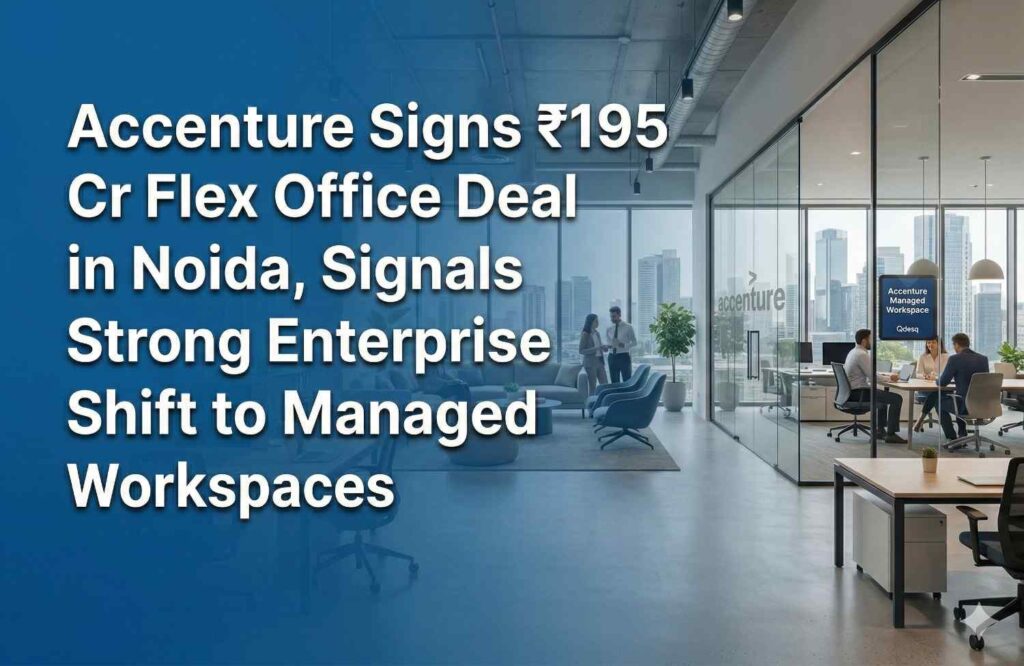
Accenture has leased 1.65 lakh sq. ft. office space in Noida for ₹195 crore over five years through a managed workspace operator. The deal highlights rising enterprise demand for flexible offices, driven by GCC expansion, cost efficiency, and hybrid work strategies across India’s top commercial real estate markets.
India’s flexible office market continues to attract large enterprises, with Accenture leasing 1.65 lakh square feet of office space in Noida’s Sector 132. The five-year deal, valued at approximately ₹195 crore, reflects a clear shift in how corporates are approaching commercial real estate—prioritising flexibility, scalability, and speed over traditional long-term leases.
The office space, located in ACE Capitol Tower 2 and leased from a managed workspace operator, spans multiple floors and comes with a starting monthly rent of ₹3.17 crore. The agreement includes a 6% annual escalation, underlining long-term commitment while maintaining operational agility.
According to transaction data, the rent is approximately ₹192 per square foot for a chargeable area of nearly 1.65 lakh square feet.
Flex Spaces Become Enterprise-Ready
This deal is not an isolated transaction. It represents a broader transformation where flexible workspace providers are becoming key partners for large corporations. Traditionally seen as a startup-focused solution, managed offices are now catering to enterprise-grade requirements, including compliance, security, and customisation.
The model allows companies like Accenture to expand quickly without the delays associated with traditional fit-outs. It also reduces upfront capital expenditure, making it an efficient solution in an uncertain global environment.
Multi-City Expansion Strategy
Accenture’s leasing activity is not limited to Noida. The company has also taken up additional office space in Coimbatore, signalling a multi-city expansion strategy aligned with talent availability and cost optimisation.
Such moves highlight how enterprises are diversifying their office footprint across Tier-I and emerging cities, balancing scale with operational efficiency. This approach is particularly relevant for Global Capability Centres (GCCs), which continue to drive a significant share of office demand in India.
GCC Demand Drives Market Growth
The rise of GCCs remains a key factor behind strong leasing momentum. These centres are expanding across technology, consulting, and business services, requiring high-quality, scalable office infrastructure.
Industry data supports this trend. As noted by a leading real estate consultancy, “India’s office market in metro cities has seen a 15 per cent year-on-year growth in office leasing for the January to March period of 2026,” driven by expanding GCC footprints and strong occupier demand.
Flexible workspace operators are playing a crucial role in this ecosystem. They leased nearly 13 million square feet last year and are expected to take up 15–18 million square feet this year, reflecting growing enterprise adoption.
Coworking Operators Scale Up
For operators, large deals like this validate their evolving business model. By leasing large office spaces from developers and sub-leasing them to corporates, they bridge the gap between real estate supply and enterprise demand.
This approach also enables companies to enter the market faster, especially in competitive business districts such as Noida, Bengaluru, and Hyderabad. With hybrid work becoming the norm, flexibility in lease terms and space utilisation is now a strategic advantage rather than a temporary solution.
The Bigger Picture
Accenture’s Noida lease highlights a structural shift in India’s commercial real estate landscape. Flexible workspaces are no longer an alternative—they are becoming central to enterprise real estate strategies.
As demand continues to grow, the focus will likely remain on scalability, cost efficiency, and execution speed. For developers and operators alike, aligning with these priorities will be critical to capturing the next wave of office demand in India.