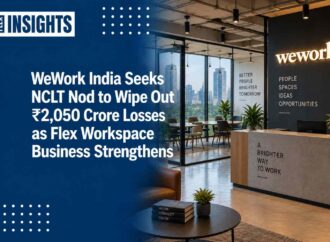

India’s office market remains robust, with rentals rising 6% across major cities and vacancy levels easing to 16.2%. Pune saw a record 97% growth in office absorption, driven by GCCs and flexible workspaces. Bengaluru and the Delhi-NCR region led overall leasing, while the coworking and IT/ITeS sectors continued to drive demand for high-quality Grade A offices.
India’s Office Market Maintains Strong Momentum
India’s commercial real estate market continues to strengthen as office rentals rose 6% year-on-year across the top seven cities, according to the latest report by ANAROCK. Average monthly rentals increased from ₹85 per sq. ft. in 9M 2024 to ₹90 per sq. ft. in 9M 2025, signalling healthy demand and consistent occupier confidence in the country’s key office hubs.
The IT/ITeS sector remained the largest occupier, accounting for 27% of total leasing, followed by coworking operators (23%) and the BFSI segment (18%). The data reflects India’s continued transition toward hybrid and flexible workspace models, where adaptability and cost-efficiency are driving occupier decisions across scales.
Pune Emerges as the Fastest-Growing Market
Among India’s major cities, Pune recorded the highest growth in net office absorption—up by a staggering 97%, from 3.14 million sq. ft. in 9M 2024 to 6.2 million sq. ft. this year. The city’s expanding base of technology firms and global capability centres (GCCs) has transformed it into one of India’s most dynamic commercial office destinations.
Bengaluru retained its leadership with 9.95 million sq. ft. of net leasing, followed by Delhi-NCR (8.2 million sq. ft.) and the Mumbai Metropolitan Region (6.6 million sq. ft.). In contrast, Kolkata was the only market to witness a decline, with leasing activity dropping by 19%.
Coworking and Flex Spaces Continue to Gain Ground
Coworking spaces are consolidating their position as a critical growth pillar of India’s office market. Their share of total leasing rose to 23%, reflecting the increasing preference among corporates for flexible and hybrid work setups. “Multiple factors are driving office space demand in the country despite all headwinds,” said Anuj Puri, Chairman, ANAROCK Group.
He added, “Several companies are now looking for high-quality Grade A office spaces with better infrastructure, amenities, and sustainability features. Supply is following this growing demand.” The report attributes much of this momentum to the rise of managed office solutions and green-certified buildings that align with companies’ ESG goals and evolving workforce preferences.
GCCs Remain the Powerhouse of Leasing
Global Capability Centres (GCCs) remain the single most significant driver of office space leasing in India. They accounted for over 40% of total gross leasing, translating to 23.34 million square feet out of 58.28 million square feet recorded during the first nine months of 2025.
“GCCs are a major driver of office space leasing in the top seven cities,” said Puri. Bengaluru led GCC leasing with 8.3 million square feet, followed by Pune (3.73 million square feet) and Chennai (3.57 million square feet). This growth reflects India’s expanding role as a global hub for shared services, innovation, and R&D operations.
Strong Supply Pipeline and Lower Vacancy
Despite the steady rise in new office completions, vacancy levels across India’s top cities fell marginally from 16.7% to 16.2%, underscoring sustained occupier demand. Chennai emerged as the most stable market, reporting the lowest vacancy rate at 8.9%.
The report concludes that with rising demand for Grade A spaces, improved infrastructure, and expanding GCC activity, India’s commercial real estate sector is well-positioned for long-term growth, making it one of the most resilient office markets globally.