
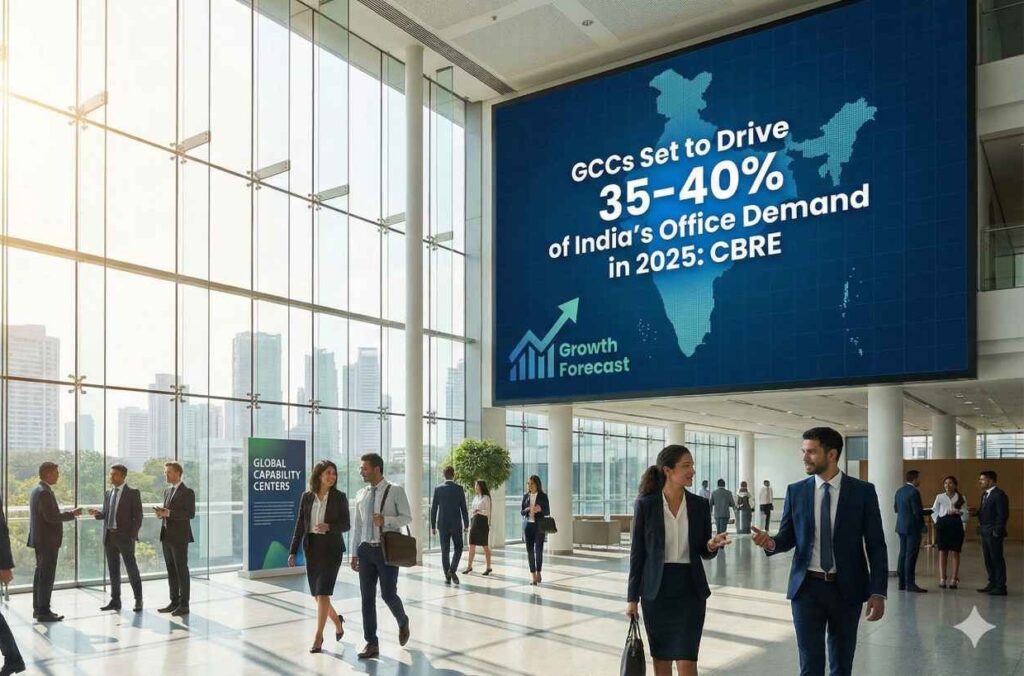
Global Capability Centres are expected to account for 35–40% of India’s total office demand in 2025, according to CBRE South Asia. With gross leasing likely to exceed 80 million sq ft, demand is being fuelled by large deals, premium office assets, sustainability-led design, and continued expansion by GCCs and flex operators.
Global Capability Centres (GCCs) are rapidly becoming the backbone of India’s office real estate market. According to a new report by CBRE South Asia Private Limited, GCCs are expected to contribute 35–40 per cent of total office demand in 2025. Their growing influence is already visible, with GCCs accounting for more than 55 per cent of large office transactions during the first nine months of CY25, reinforcing India’s position as a global services and operations hub.
Record Leasing Momentum Continues
India’s office sector is on track for another landmark year. The report highlights that “resilient demand fundamentals” have supported strong leasing activity, with gross office leasing expected to cross 80 million sq ft in 2025. Nearly 60 million sq ft was already leased between January and September, marking the highest-ever leasing volume for the first nine months of any year. This sustained momentum reflects occupier confidence despite global uncertainty.
What’s Driving Demand in 2026 and Beyond
CBRE forecasts that the same “resilient demand fundamentals” will continue to support leasing momentum in 2026. Key drivers include portfolio expansion by large enterprises, workplace reconfiguration, and a growing preference for “premium, future-ready assets.” Occupiers are increasingly upgrading to high-quality buildings that support flexibility, collaboration, and long-term efficiency rather than simply expanding their footprint.
Sustainability and Experience Take Centre Stage
Sustainability has become a decisive factor in leasing decisions. The report notes a growing focus on ESG, with most occupiers already having defined sustainability goals. About 84 per cent of new office supply delivered during the period was green-certified, while 77 per cent of leasing activity took place in such projects. Tenants are also investing in collaborative and innovation-led layouts, increasing demand for “experience-driven environments” that blend technology, comfort, and productivity.
Sectoral Trends and the Rise of Large Deals
Office demand remains broad-based across sectors. Technology firms continue to lead leasing activity, supported by flex operators, BFSI players, and engineering and manufacturing companies. Large transactions are playing a bigger role, with deals above 100,000 sq ft accounting for 38 per cent of total absorption in the first nine months of 2025, up sharply from 27 per cent a year earlier. This shift highlights the growing preference for consolidation and campus-style offices.
Broader Real Estate Market Signals
Beyond offices, the report points to steady growth across other asset classes. Industrial and logistics leasing gained momentum, driven by 3PL and e-commerce players, with Delhi NCR, Bengaluru, and Hyderabad together capturing nearly 60 per cent of demand. Retail leasing reached 4.6 million sq ft, led by fashion and apparel brands, while residential sales crossed 2.1 lakh units in the same period. Equity investments in real estate rose 14 per cent year-on-year to $10.2 billion, with full-year inflows projected at $12–14 billion. Overall, the findings underline how GCC-led expansion, sustainability-first design, and large-format leasing are reshaping India’s office and flexible workspace landscape.