
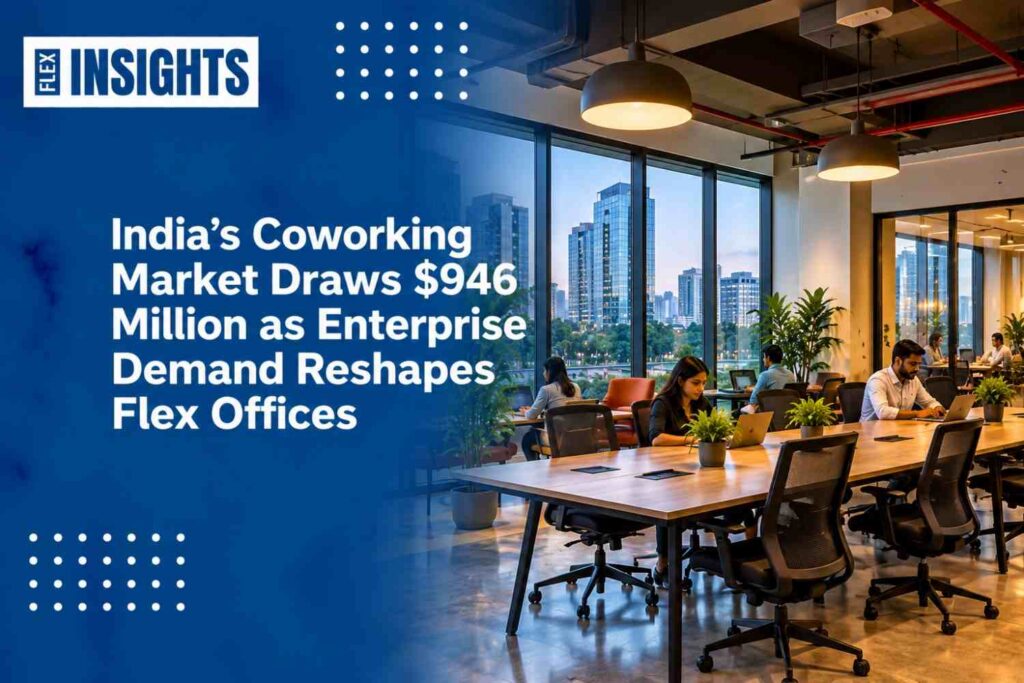
India’s coworking sector is seeing a clear shift toward enterprise-led demand, with large companies occupying 72% of managed workspace seats and GCCs accounting for 52% of demand. Coworking operators leased 24% of office space across eight major cities in H1 2026, while private equity investment reached $945.5 million since 2016.
India’s coworking sector is seeing a clear shift toward enterprise-led demand, with large companies occupying 72% of managed workspace seats and GCCs accounting for 52% of demand. Coworking operators leased 24% of office space across eight major cities in H1 2026, while private equity investment reached $945.5 million since 2016.
India’s coworking and managed workspace market is moving well beyond its traditional base of freelancers, startups and small businesses. Large enterprises now account for 72% of seats in managed workspace centres, according to Knight Frank India, highlighting the growing role of flexible offices in corporate real estate strategies.
Global Capability Centres (GCCs) are another major demand driver, accounting for 52% of demand based on end use. The numbers point to a wider shift in how companies approach office capacity, with managed workspace allowing occupiers to add or reduce space based on business requirements.
The trend is also visible in overall leasing activity. Coworking operators accounted for 24% of the 48 million sq ft of office space leased across eight major Indian cities between January and June 2026.
Private Equity Interest Picks Up
The sector has also attracted significant institutional capital. Knight Frank data shows that coworking operators received $945.5 million in private equity funding between 2016 and June 2026. The strongest year was 2022, when PE investment reached $594.5 million.
Investment activity has started to pick up again in 2026. The segment attracted $30.9 million in the first half of the year, already exceeding the $24.3 million recorded for all of 2025.
For operators, the growing access to capital comes as the business model continues to evolve. Coworking companies typically lease office space from developers, build and operate managed centres, and then sub-lease space to businesses.
Flex Becomes Part of Corporate Real Estate
Viral Desai, Senior Executive Director, Occupier Strategy Solutions, Industrial & Logistics, Capital Markets & Retail, Knight Frank India, said, “The increasing share of flexible space absorption reflects a broader evolution in occupier real estate strategies in India’s commercial market.”
He added that “converting fixed real estate commitments into variable capacity” allows businesses to align office requirements with the pace and uncertainty of growth, while creating an intermediary layer between landlords and occupiers.
This shift is particularly relevant for GCCs and large companies that may need to enter new markets, expand teams or adjust their office footprint without taking on long-term conventional leases.
Listed Operators Expand the Sector’s Profile
The changing demand profile is also reflected in the sector’s corporate landscape. WeWork India, Smartworks, Awfis, and IndiQube are among the managed workspace operators now listed on stock exchanges.
The Executive Centre and Table Space have also filed documents with SEBI for proposed initial public offerings. Other significant operators include Incuspaze, Simpliwork Offices, Urban Vault, 91Springboard, Spring House Workspaces, BHIVE Workspace, 315Work Avenue, The Office Pass and Hanto Workspaces.
Desai said the growing use of managed workspace by enterprises and GCCs, along with changes in investment patterns, suggests that flexibility is becoming “a structural part of India’s office market.” He added that flex can support “market entry, expansion and the faster absorption of office space.”
For India’s office sector, the trend points to a changing relationship between landlords, occupiers and flexible workspace operators, with flex increasingly serving as a strategic real estate option rather than simply an alternative workplace format.

























Leave a Comment
You must be logged in to post a comment.