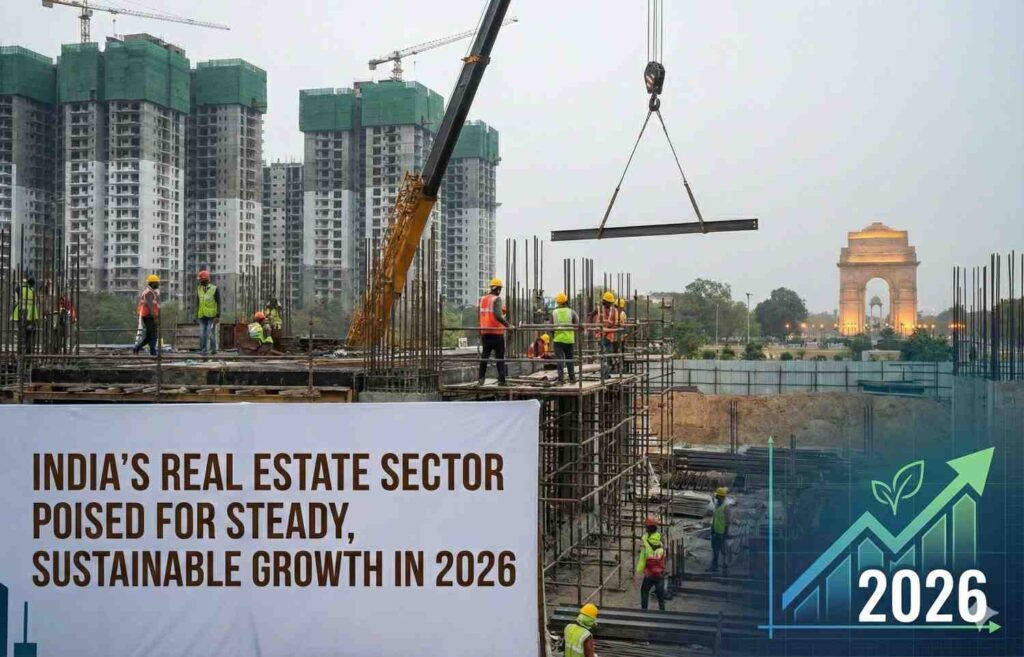
India’s real estate market is set for measured and sustainable growth in 2026, backed by strong GDP momentum, supportive fiscal and monetary policies, and rising office demand. Experts point to expanding GCC activity, consolidation among flex workspace operators, and increasing real estate opportunities across Tier-II and Tier-III cities.
As India steps into 2026, the real estate sector is poised for balanced, sustainable growth across residential, commercial, and industrial segments. Industry experts say the year will mark a recalibration phase after macroeconomic and geopolitical challenges tested markets in 2025. Despite these pressures, investor confidence has remained intact, supported by strong domestic fundamentals and continued interest from global capital.
Shrinivas Rao, FRICS, CEO of Vestian, pointed to India’s economic resilience as a key factor shaping the outlook. “This outlook is supported by India’s strong GDP growth of 8.2 per cent in Q2 FY26, recorded despite global uncertainties and shifting trade dynamics,” he said, adding that India remains on track to become the world’s third-largest economy by 2030, with an estimated GDP of $7.3 trillion.
Policy Support Strengthens Market Sentiment
Government intervention has played a critical role in stabilising the real estate environment. Fiscal measures such as rationalising GST rates and revising income tax slabs have helped improve consumer sentiment and liquidity. On the monetary side, the Reserve Bank of India’s decision to reduce the repo rate to 5.25 per cent while maintaining a neutral stance is expected to support borrowing and investment activity through 2026.
These combined measures are likely to encourage long-term capital deployment across asset classes, from premium housing to income-generating commercial real estate.
Office Market Momentum Continues
The office segment is expected to remain a key growth engine in 2026. According to Vestian Research, gross office absorption is projected to reach 75–80 million square feet, driven largely by sustained expansion from Global Capability Centres. IT-ITeS and BFSI occupiers will continue to anchor demand, while multinational firms deepen their presence in India.
Rao noted that flexible workspace operators will further strengthen their market position as companies prioritise agility and hybrid work models. Leasing activity is expected to be led by Bengaluru, Chennai, and Hyderabad, with Mumbai and Pune likely to capture a larger share of transactions than in previous years.
Flex Spaces and Emerging Cities Gain Ground
Flex operators are increasingly becoming a structural part of India’s office ecosystem rather than a short-term solution. As enterprises seek shorter lease tenures, scalability, and cost efficiency, managed and coworking spaces are set to see deeper penetration across both metros and emerging business districts.
Prashant Sharma, President of NAREDCO Maharashtra, highlighted a broader geographic shift underway. “Tier-II and Tier-III cities are set to play a larger role in India’s real estate growth story in 2026,” he said, citing improved connectivity, rising employment, and new industrial corridors as key drivers.
Commercial Real Estate Outlook Remains Positive
Looking ahead, demand fundamentals for commercial real estate remain strong. Aniket Dani, Director at Crisil Intelligence, said demand is expected to rise 5–7 per cent, while supply could grow 9–11 per cent, supported by leasing from GCCs, flex operators, and core sectors like IT and BFSI. With improving infrastructure and lower interest rates, the sector appears well-positioned for stable, long-term growth beyond 2026.