
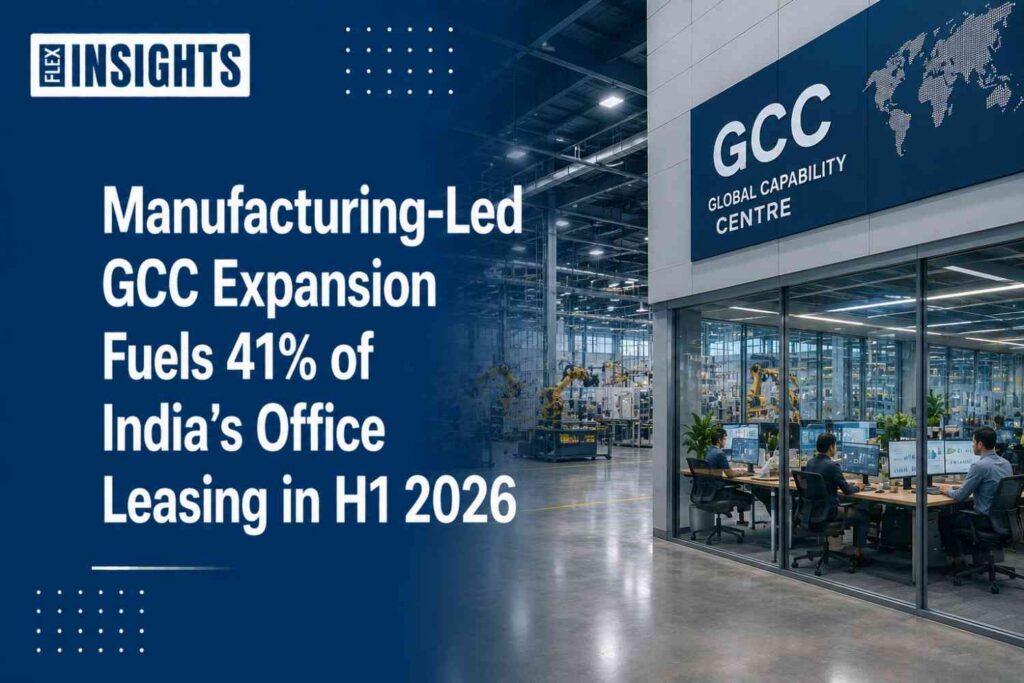
Manufacturing companies have emerged as the biggest growth driver in India’s office market, contributing 41.7% of office leasing through GCCs in H1 2026. Rising investments in AI, engineering, and R&D have supported demand for Grade A office space, keeping vacancy rates at a five-year low despite a slight market slowdown.
India’s office real estate market is witnessing a major transformation as manufacturing companies become one of the strongest drivers of workspace demand. During the first half of 2026, Global Capability Centres (GCCs) leased 15.8 million square feet of office space, accounting for 41.7% of total office leasing across the country’s seven largest cities. The trend marks a significant shift from the traditional dominance of technology and banking firms, with manufacturing companies now playing a central role in shaping commercial real estate demand.
AI and Product Engineering Drive Premium Workspace Needs
The latest wave of GCC expansion goes beyond conventional back-office operations. Global manufacturers are increasingly establishing Indian hubs focused on product engineering, research and development (R&D), artificial intelligence (AI), and digital engineering. These advanced business functions require larger, smarter, and more collaborative Grade A office campuses equipped with modern infrastructure.
The expansion is also broadening across industries. Alongside manufacturing, companies from the retail, logistics, infrastructure, and aerospace sectors are strengthening their presence in India, creating a more diversified occupier base. This evolution reflects India’s growing importance as a global innovation and engineering destination rather than just a cost-efficient outsourcing market.
GCC Growth Keeps Vacancy Rates at Five-Year Low
Although India’s overall office leasing declined 3.9% year-on-year to 37.9 million square feet during H1 2026, the GCC segment continued to outperform. Leasing by Global Capability Centres increased 14.2% compared with the same period last year, providing crucial support to the commercial office market.
As a result, office vacancy across the top seven cities remained at 14.5%, the lowest level recorded in five years. This resilience suggests that while many companies continue to optimise office portfolios amid global economic uncertainty, demand for premium, innovation-focused workspaces remains strong. The market is increasingly favouring high-quality office assets capable of supporting advanced research, engineering, and technology operations.
What This Means for Developers and Investors
The growing influence of manufacturing-led GCCs presents a positive outlook for developers focused on Grade A office buildings and integrated business parks. As multinational companies continue relocating strategic business functions to India, the demand for high-performance office campuses is expected to remain steady over the long term.
However, the sustainability of this momentum will depend on continued global corporate expansion, supportive infrastructure, and India’s ability to accommodate large-scale technical operations. Market watchers will closely track leasing activity in major technology corridors and the quarterly performance of commercial real estate developers to assess whether this manufacturing-led GCC growth continues throughout the rest of 2026.
With AI, engineering, and product innovation becoming central to corporate expansion strategies, India’s office market appears to be entering a new phase where manufacturing companies are driving not only industrial growth but also the future of commercial real estate.