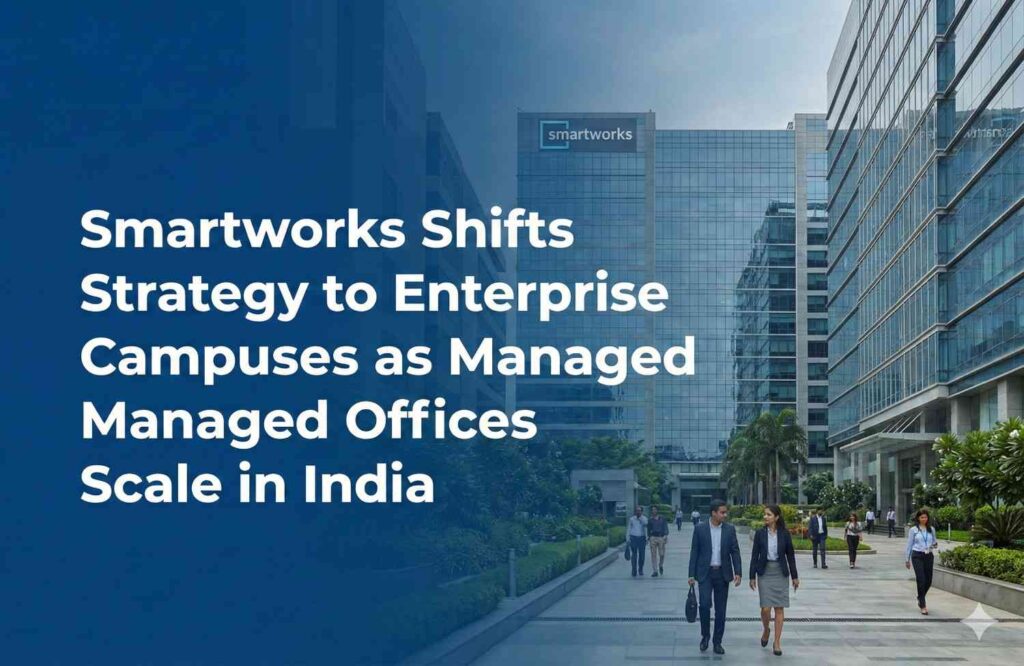
Smartworks Coworking Spaces is repositioning toward large enterprise mandates, targeting requirements of 300+ and 1,000+. In an interaction with Fortune India, co-founder Harsh Binani highlighted rising GCC demand, long-term contracts, and asset-light expansion as key drivers shaping India’s evolving managed office infrastructure market.
India’s flexible workspace market is rapidly evolving, and Smartworks is reshaping its strategy to align with this shift. Moving beyond traditional coworking models, the company is focusing on enterprise-scale managed campuses designed for large occupiers seeking long-term real estate solutions. The strategy prioritises mandates of 300 seats and above, with an increasing push toward 1,000-seat enterprise deployments.
Speaking in an interaction with Fortune India, Harsh Binani explained the company’s repositioning, stating, “We don’t see ourselves as a co-working company. We are building enterprise infrastructure. Our sweet spot is 300-plus seats, and increasingly 1,000-plus seat mandates.” This approach reflects a broader structural transition in how corporates consume office space, particularly as hybrid work and cost optimisation reshape portfolio strategies.
Large Mandates Driving Revenue Stability
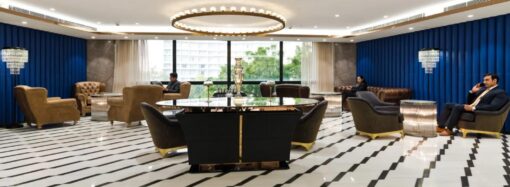
Smartworks currently operates over 15.3 million square feet across 63 centres in India and Singapore, serving more than 770 enterprises, including multinational corporations, Fortune 500 firms, and Global Capability Centres (GCCs). The company’s shift toward large-format mandates is already evident in its revenue composition, with the 1,000-plus-seat category accounting for roughly 35% of rental income.
Binani compared the managed office boom to earlier outsourcing waves, noting, “This is a structural shift similar to what IT outsourcing was two decades ago. We are just at the tip of the iceberg.” Large campuses also allow operators to build integrated amenities and deliver cost efficiencies at scale, strengthening long-term client retention.
The strategy contrasts with smaller coworking formats that depend heavily on short-term occupancy. Smartworks instead signs long-term leases with landlords and builds customised enterprise environments, improving revenue visibility and reducing volatility.
GCC Expansion Strengthens Demand Outlook
India’s strong macroeconomic environment and the rapid expansion of GCCs are further accelerating demand for professionally managed office infrastructure. Enterprises increasingly prefer plug-and-play campuses that allow faster scaling without heavy upfront capital investment.
Highlighting the scale opportunity, Binani said, “India is becoming an attractive destination for global companies to set up GCCs. At the same time, commercial real estate supply has not kept pace with demand. In totality, we are seeing an unprecedented surge.” Despite managed offices currently accounting for nearly 10% of India’s office stock, the company expects massive long-term growth.
He added that even without a major jump in penetration, India could add nearly a billion square feet of office space over the next two decades, reinforcing the depth of the opportunity.
Profitability and Operating Leverage Improve
Smartworks recently reported a profitable quarter under Indian accounting standards, marking a milestone in its operational journey. For Q3 FY26, the company posted a net profit of ₹1.2 crore compared to losses in earlier quarters, supported by higher occupancy and large enterprise deals. Total income rose 34% year-on-year to ₹488.14 crore, while EBITDA reached ₹85 crore with margins nearing 18%.
Binani emphasised that profitability improvements are structural rather than cyclical, stating, “This is not a one-off quarter phenomenon. It’s structural compounding.” With older campuses stabilising and new centres benefiting from operating leverage, margin expansion is expected to continue.
Asset-Light Model and Technology-Led Execution
Smartworks continues to follow an asset-light strategy by leasing large campuses instead of owning real estate, reducing balance-sheet risk while enabling faster expansion. Technology also plays a central role, with in-house platforms supporting supply identification, design execution, and workspace management.
Looking ahead, the company aims to scale to 30 million square feet over the next few years, adding roughly 3 million square feet annually. As enterprises increasingly shift toward managed infrastructure models, Smartworks believes the next decade will be transformational for the flexible workspace sector.