
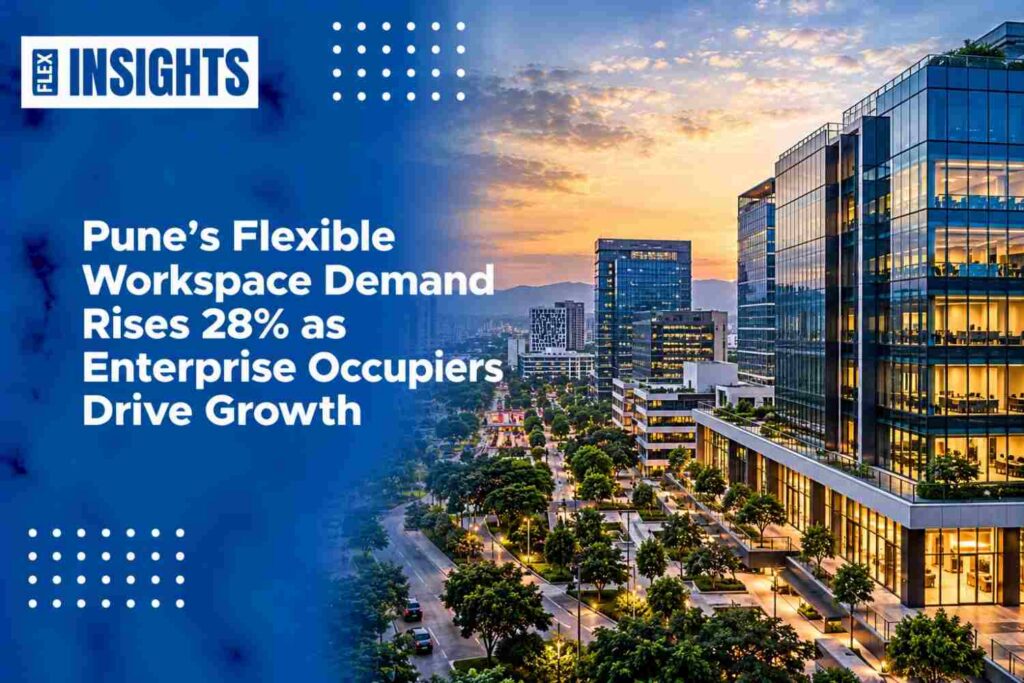
Pune’s flexible workspace market recorded a 28% year-on-year rise in leasing during the first half of 2026, with 20,900 seats taken up. Demand from IT, engineering, BFSI and GCCs is supporting growth across key micro-markets. Operators expect further expansion, with managed offices and enterprise-focused solutions gaining ground.
Pune is strengthening its position as one of India’s fastest-growing flexible workspace markets, supported by demand from companies across technology, engineering, banking, financial services and global capability centres (GCCs).
According to a report by Cushman & Wakefield, 20,900 flexible workspace seats were leased in the first half of 2026, up 28% from the same period last year. Baner, Viman Nagar and Kharadi were among the micro-markets attracting strong demand.
The growth reflects how businesses are using coworking and managed offices to establish teams, expand operations and access office space without taking on the cost and commitment of setting up traditional workplaces.
Pune’s Flex Market Expands Beyond Startups
Pune’s flexible workspace footprint has grown significantly in recent years. According to JLL, operators have leased more than 7 million sq ft since 2024, representing around 30% of the city’s overall office leasing activity. The city’s flexible workspace stock stands at approximately 15 million sq ft, making it the third-largest market among India’s top seven cities, according to the report.
Rohan Sharma, Senior Director of Research and REIS at JLL India, said, “We expect the flex footprint to grow to over 20 million sq ft over the next year.”
Flexible offices are also attracting smaller businesses that want room to grow. Nidhi Sharma, who runs an apparel startup from a coworking facility in Kharadi, said, “It is now so easy to just start operations from a co-working space rather than setting up a full-fledged office.”
For growing teams, the model offers the option to add seats as hiring needs change. Tech startup founder Tarun Rathod, who began with three seats and now has a six-member team, has expanded into a slightly larger space.
Operators Prepare for Further Growth
For Awfis, Pune has evolved from a supporting market into a core part of its business. Chairman and Managing Director Amit Ramani said, “The West zone, anchored strongly by Pune and Mumbai, accounts for 34% of our business.” He added that Pune would be a meaningful part of the company’s plan to add 22,000–25,000 seats across its network.
The next stage of growth may also bring a shift towards larger corporate requirements. Pratyush Pandey, founder of AARE Consulting, expects established business hubs such as Hinjewadi, Baner, Kharadi and Viman Nagar to see greater adoption.
“The next wave of supply is likely to be more enterprise-oriented, with managed offices, customised solutions and larger floor plates gaining prominence,” Pandey said.
India’s Flexible Workspace Market Keeps Growing
The expansion in Pune mirrors a wider national trend. Anarock Research estimates that flexible workspace stock across India’s seven largest cities stands at 90–95 million sq ft. The total could reach 100 million sq ft by the end of 2026 and 125 million sq ft by March 2027.
Bengaluru, Delhi-NCR, Mumbai, Hyderabad and Pune remain among the strongest markets, while Chennai and Noida are also gaining traction.
In Pune, flex seat prices range from ₹10,000 to ₹35,000, depending on location and services. As demand grows, operators are likely to focus on the right mix of affordability, enterprise-grade facilities and flexibility to meet changing workplace needs.
























Leave a Comment
You must be logged in to post a comment.