
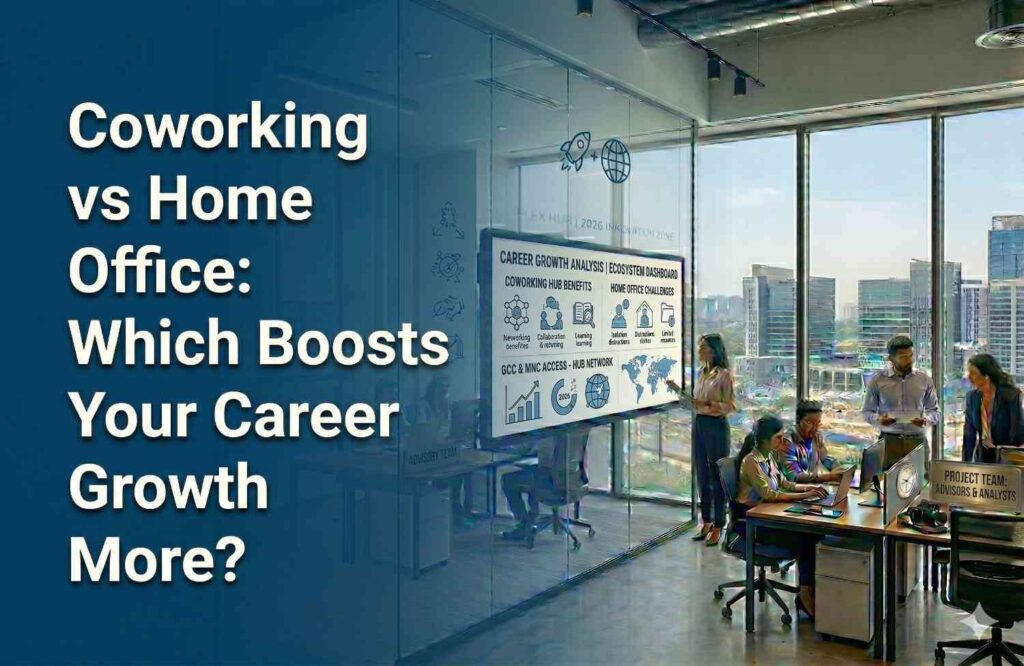
This guide explores how coworking spaces and home offices impact career growth. From productivity and networking to flexibility and well-being, it compares both environments in depth. Backed by research and practical insights, it helps professionals choose the workspace that best accelerates long-term success and personal development.
Imagine your career as a high-performance engine; the environment you choose acts as the premium fuel that determines your top speed. You can often find yourself at a professional crossroads, weighing the cosy silence of a home office against the vibrant, electric energy of a coworking hub.
While one offers the ultimate sanctuary for deep focus and personal comfort, the other serves as a bustling ecosystem where serendipity and networking flourish naturally. Choosing the right physical workspace is about far more than just finding a desk. It is a strategic decision that shapes your daily habits, your mental clarity, and your access to life-changing opportunities.
Let’s explore how these two distinct worlds influence your trajectory and help you discover which setting truly unlocks your highest potential.
Career Growth Essentials: What Really Moves the Needle
Before comparing workspaces, it’s important to define what we mean by career growth. Real career advancement means:
- Learning new skills
- Expanding your professional network
- Collaborating and innovating
- Maintaining productivity and focus
- Improving well-being and motivation
- Enhancing professional credibility
These are some measurable contributors to success in today’s dynamic, often remote world of work.
Coworking Spaces: A Launchpad for Professional Momentum
Let’s start with a snapshot of coworking trends. Research consistently shows that when professionals shift from working at home to coworking spaces, many markers of career progress improve.
According to recent data from the coworking industry, about 74% of professionals report higher productivity in coworking spaces than in their home offices. While 82% say their professional network expanded significantly after joining a shared workspace. Moreover, nearly 9 in 10 members say coworking has made them happier, and 83% feel less isolated, showing that coworking can support both career and well-being.
So what’s driving that?
Community & Networking: The Secret Sauce
In a coworking space, you’re surrounded by people who are also building, hustling, and creating. This proximity ignites spontaneous conversations, the kind of conversations that lead to collaborations, client referrals, mentorship opportunities, and even future partnerships. We all know that networking doesn’t happen by scheduling Zoom calls; it happens over coffee or on a whiteboard.
Coworking hubs often host mixers, workshops, and professional events that help forge real connections. This sets them apart from remote work’s digital-only interactions.
Creativity & Cross-Pollination of Ideas
Have you ever noticed how great ideas often come from unplanned conversations? Coworking draws people from diverse industries under one roof. This diversity supercharges creativity and opens perspectives you’d rarely encounter working alone. It’s like a brain gym where energy and ideas feed off one another.
Professional Identity & Credibility
Working from home often lacks external validation. Meeting clients at a coworking hub or inviting collaborators into a sleek meeting room enhances your professional image. Many coworkers report improved collaboration skills, self-confidence, and business connections, all of which are key components of career growth.
Structure Boosts Productivity
A dedicated workspace creates psychological separation between personal life and work life. This helps in establishing a routine, accountability, and focus. Many remote professionals report that the transition from commuting to working from home actually helps them “switch on” and stay disciplined.
Home Office: Freedom, Comfort & Some Hidden Costs
On the flip side, working from home offers undeniable benefits.
Flexibility & Comfort
No commute, no dress code and total control over your environment. These perks make your life easier, especially for introverts or those with family commitments. Remote work settings have been linked to increased employee satisfaction and reduced stress. Particularly when individuals can create a personalised workspace.
Lower Costs (Long-Term Savings)
You have to spend zero on monthly coworking fees and daily transport costs. Remote workers avoid office-related expenses such as travel, lunch outings, and professional attire. This financial flexibility can help you free up your budget for training, certifications, or tools that help boost your career.
Minimal Interruptions (For the Right Person)
Some professionals focus best in quiet spaces with complete control over noise and setup. For deep, solitary work that requires hyper-focus or for those comfortable with solo learning, home offices can outperform shared spaces.
But… there’s a catch.
The Real Challenges of Working Solo at Home
While you find the comforts and savings of home offices appealing, there are still downsides that often go unspoken, and they hit career growth directly.
Isolation and Motivation Loss
Without regular interactions, you can often experience loneliness, and that can chip away at creativity, motivation, and emotional resilience. In one industry report, loneliness was cited as a major challenge for remote professionals.
When you’re the only voice in the room, idea-exchange dries up, and so can opportunities.
Blurred Work-Life Boundaries
You can often struggle to separate your work time from personal life. This can lead to burnout rather than sustainable productivity.
Limited Networking
While virtual events and platforms help, they rarely match the spontaneous, organic professional interactions that happen in shared workspaces. As a remote worker, you have to actively seek out community; otherwise, you will miss out on a lot.
Coworking vs Home Office: The Direct Comparison
Here’s a straightforward comparison on key career growth drivers:
| Factor | Coworking Spaces | Home Office |
| Networking | Built-in opportunities | Limited without extra effort |
| Productivity | Structured focus, routines | Varies by personality |
| Creativity & Collaboration | High cross-pollination | Requires intentional outreach |
| Cost Efficiency | Membership fees | No workspace costs |
| Flexibility | Flexible, but location-dependent | Total control at home |
| Isolation Risk | Social environment | High risk of loneliness |
| Professional Presence | Dedicated workspace + meeting rooms | Virtual-only |
The Hybrid Sweet Spot: Best of Both Worlds
Here’s where the future of work gets interesting. Gallup and workplace research reveal that hybrid work arrangements, which combine home offices with coworking or flexible workspaces, increasingly deliver the best career outcomes.
Why? Because you get:
- Quiet, comfortable focus time at home
- Community, routine, and spontaneous collaboration in coworking hubs
- Professional meeting spaces without long-term rent
- Better mental health and work-life balance
- A rhythm that supports both creativity and discipline
Final Takeaways: So What Really Boosts Your Career?
- If your career depends on networking, innovation, and visibility, coworking spaces are the way to go.
- If your strengths lie in autonomy, minimal interruptions, and routine, a home office might be perfect for you.
- But for most people aiming for long-term growth, a hybrid approach wins.
Coworking spaces elevate connection, community, and professional presence. The things no amount of Zoom calls can fully replicate. Meanwhile, your home office gives you peace, flexibility, and focus. The key is designing a work routine that uses “BOTH”.
Conclusion
Your workspace shapes your career trajectory. Coworking spaces aren’t limited to shared desks and internet. They’re ecosystems built for growth. They create visibility, spark interactions, support well-being, and build momentum in ways that a quiet home room rarely can.
But at the end of the day, growth isn’t purely about where you work; it’s about how intentionally you build your skills, community, and professional routines. So ask yourself: Are you building for connection or comfort? Because the right workspace will help you grow both.